
When it comes to differences in dog and cat behavior, architecture is key. Dogs are social-group animals that enjoy company and require walks and training. Cats are solitary hunters. They need territory and vertical space, and a litter tray. Dogs are louder, barking at 80–90 decibels, and cost more to set up and run. Cats stay quiet and live longer.
What follows is a result of the primary difference and includes what happens if you have both.
What is the main difference between a dog and cat?
A dog is a social animal built around the group. A cat is an individual animal built around the territory it owns. Almost every practical difference is a result of that.
Another difference is that a dog is okay if you meet its need for company, but a cat is stressed and expects the ability to remove itself from forced company. Neither is more friendly, they are just solving different problems.
A dog is a social animal and thrives on companionship. It cannot handle long stretches of solitude. A cat does not thrive on solitude. It needs the ability to remove itself and be alone. It sees forced closeness as stress.
Dog vs cat at a glance
| What you’re comparing | Dog | Cat |
|---|---|---|
| Social blueprint | Social group animal — wants to be with you | Solitary hunter — wants the option to leave |
| Daily rhythm | Active and playful through daylight hours | Crepuscular: peaks at dawn and dusk, sleeps up to 16 hours a day |
| Daily owner time | Walks, training, outdoor toilet trips | Feeding, scooping the litter tray, short bursts of play |
| Space that matters | Floor space to burn energy | Vertical space — shelves, perches, cat trees |
| Noise | Barking at 80–90 decibels | Largely quiet |
| Grooming | Coat, teeth and feet all need your hands | Self-grooming, and smells less |
| Toilet training | Around two months to housebreak | Uses a litter tray on instinct |
| Lifespan | 12–18 years, depending on breed | 12–25 years, typically 12-14 |
| U.S. households that own one | 43.7% — 58.9 million households, 88.9 million dogs | 34.1% — 46.0 million households, 77.0 million cats |
Who are awake when
This catches people out more than cost does. Your dog’s day looks like yours. Your cat’s day peaks at dawn and dusk, with up to 16 hours of sleep in between, which is why a cat can seem aloof at 7pm and electric at 5am.
For scale: The 2026 AVMA Pet Ownership and Demographic Sourcebook puts dog ownership at 43.7% of U.S. households compared to 34.1% for cats based on an opt-in online survey of 7,547 respondents conducted in the early spring of 2026. Dogs are still leading. Cats are quickly closing the ownership gap. Owning pets, especially at this scale, makes mixed households a normal case.
How much work and money does each one actually take?
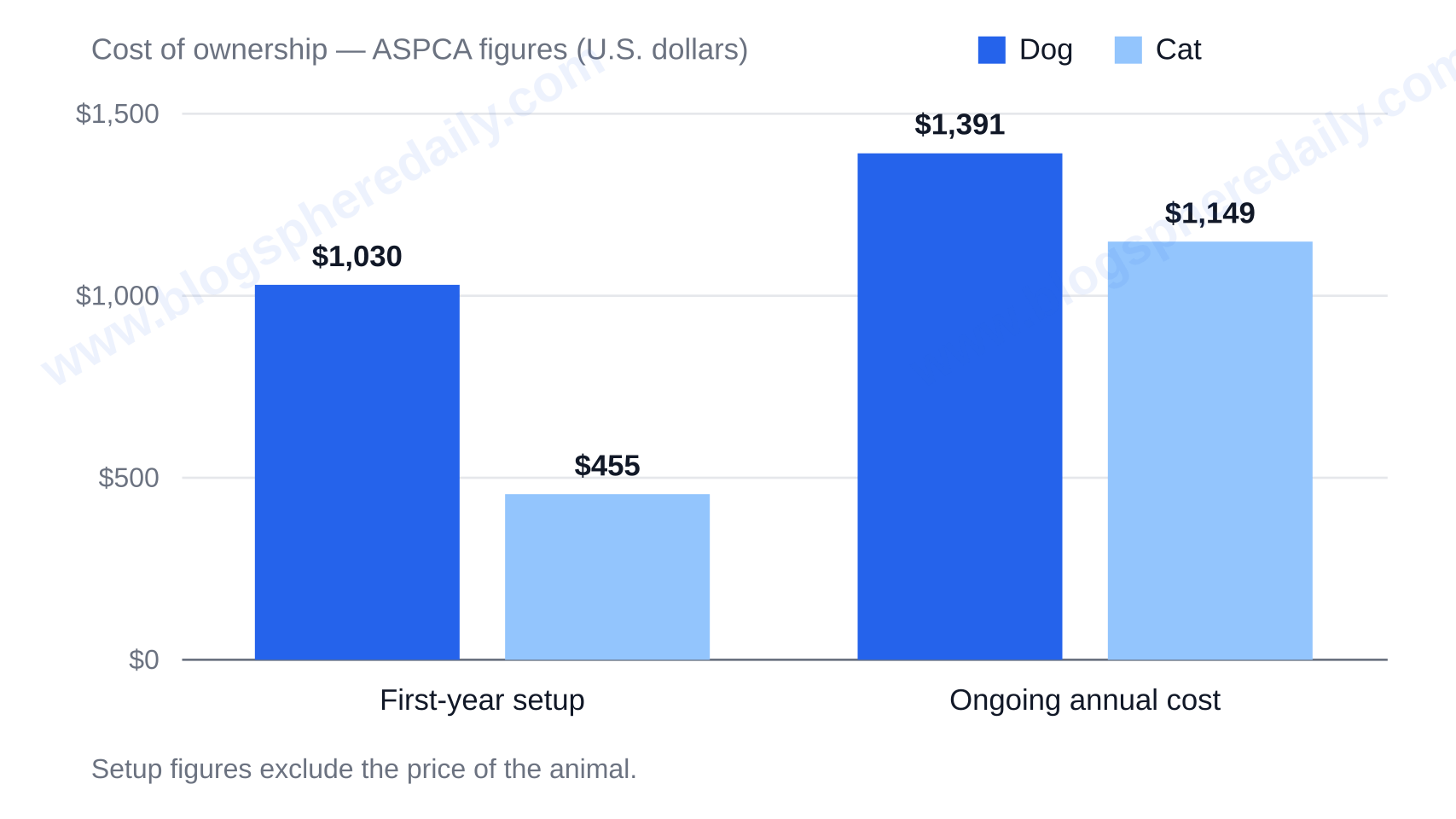
Prior costs to own a dog are approximately double those for a cat. After that, a cat will cost you less each year to own.
Setup and annual cost, side by side
| Cost line | Dog | Cat |
|---|---|---|
| First-year setup, excluding the price of the animal (ASPCA figures) | $1,030 | $455 |
| Ongoing annual cost (ASPCA figures) | $1,391 | $1,149 |
| Ongoing annual cost (Diffen, scaled by dog size) | $580 small, $695 medium, $875 large | About $670 |
The cost sets do not agree. You should see both, and not necessarily trust one of the cost sets. The ASPCA puts dog ownership numbers higher, and treat dogs like dogs; while Diffen’s puts things by size, and lands lower. In either case, the number increases as the dog gets larger.
Grooming, litter trays and toilet training
- Cats handle their own hygiene. Cats are naturally drawn to litter boxes and are very good at personal hygiene. They self-groom and smell less.
- Dogs need intervention. Coat, teeth and feet are your job, and housebreaking a dog takes around two months of consistent outdoor trips.
- Feeding differs by species, not just size. Cats and dogs are different when it comes to feeding. Cats do better with smaller, frequent meals. Dogs’ meals are set by their bodyweight.
Exercise, space and the vertical cat
A dog needs exercise in the form of daily walks and floor space. A cat needs height in the form of shelves, perches and a cat tree. A small, vertically-shaped flat is better than a large, horizontally-shaped flat for a cat.
Training works in a similar way. Dogs can handle longer training sessions in company, whereas cats need training in the form of many short, consistent sessions throughout the day.
Noise is a deciding factor for some people. Barking measures between 80 and 90 decibels and prolonged barking leads to stress and loss of sleep for the owners. For someone living in a flat with shared walls, barking is a constraint, not a quirk.
How dogs and cats communicate — and where owners misread them
Both dogs and cats misread the other’s opening move and it happens with the tail.
Dog body language
- Barking, howling and growling as the main vocal range
- Tail wagging as arousal and interest
- Direct eye contact as engagement or as a challenge
Cat body language
- Meowing as vocalization primarily directed towards humans rather than at other cats
- Hissing and snarling as clear vocalizations of warning
- Flicking tails, ear twitches and arched back as real signal set
The tail signal that means the opposite thing
A swishing tail says “friendly interest” in a dog and “I am agitated” in a cat. Direct eye contact says “engagement” to a dog and “threat” to a cat. The slow blink is the cat’s signal of relaxation and de-escalation.
Two animals meeting for the first time can both be sincere and can both be wrong.
Practical read: Watch cat ears and base of the tail rather than face and dog’s whole body rather than tail, and keep in mind the hardware is asymmetric. Cat claws are retractable and sharp, built for climbing and defense. Dog claws are blunted by ground contact. A cat’s warning swipe does real damage; a dog’s does not. That is why one swipe can end an introduction.
Are dogs smarter than cats?
A study published on 12 December 2017 in Frontiers in Neuroanatomy, and widely reported by National Geographic, concluded that dogs have more cerebral cortex neurons than cats (approximately 530 million versus 250 million, respectively). The study only counted the cells in the cerebral cortex and didn’t study intelligence in the traditional sense (e.g. problem-solving and behavior). It studied brain anatomy, and as a result, shouldn’t be used to make claims on intelligence.
What really happens when a dog and cat live in the same house?
Mostly, it works. Most guides on cat and dog cohabitation say that cats are less comfortable with the presence of dogs than the reverse, and usually don’t provide specific numbers. A PLOS ONE survey of owners whose cats and dogs share one household provided some specific data. Here are the pairs side by side.
| Behaviour reported by owners | Cat toward dog | Dog toward cat |
|---|---|---|
| Ignores the other animal | 41.8% | 28.4% |
| Hisses (cat) / growls (dog) at the other | 10.2% | 2.3% |
| Licks the other animal | 34.3% | 42.8% |
The good news is bigger than the friction
In the same survey, 68.5% of the pairs reported sleeping together at least occasionally — 57.8% occasionally, 10.7% always — and 62.4% reported playing together. Overall, only 18% of pairs were completely indifferent to each other, and under 1% of owners reported reciprocal (mutual) aggression: nine owners, with 0.5% reporting mutual attacks. 86% of the total survey reported their pairs were comfortable with each other, and only 3% reported true malice.
One of the results of this study was surprising. Managing the cat’s comfort gave better predictions of amicability than the dog’s comfort. Managing the dog’s comfort is the basis for almost all standard introduction protocols.
Why “they grew up together” is weaker advice than it sounds
Puppies and kittens raised together are not going to have any problems with each other when they meet, right? No. Not really. In that study, the age at which the two first met showed no statistical significance in the quality of the relationship and most of the first meetings occurred before 6 months of age (55.8% of the dogs, 58.0% of the cats).
What is still useful is the outcome of the puppy. Of the puppies that were exposed to a resident cat before 12 weeks, gradually, and in a home that had other dogs, they were more likely to show only desirable behaviours. Early, careful introduction helps the puppy behave. It does not promise you a famous friendship.
So plan for a pair that will tolerate each other in dog and cat households, and treat your cat’s comfort as your goal.
How do you introduce a new dog to a resident cat?
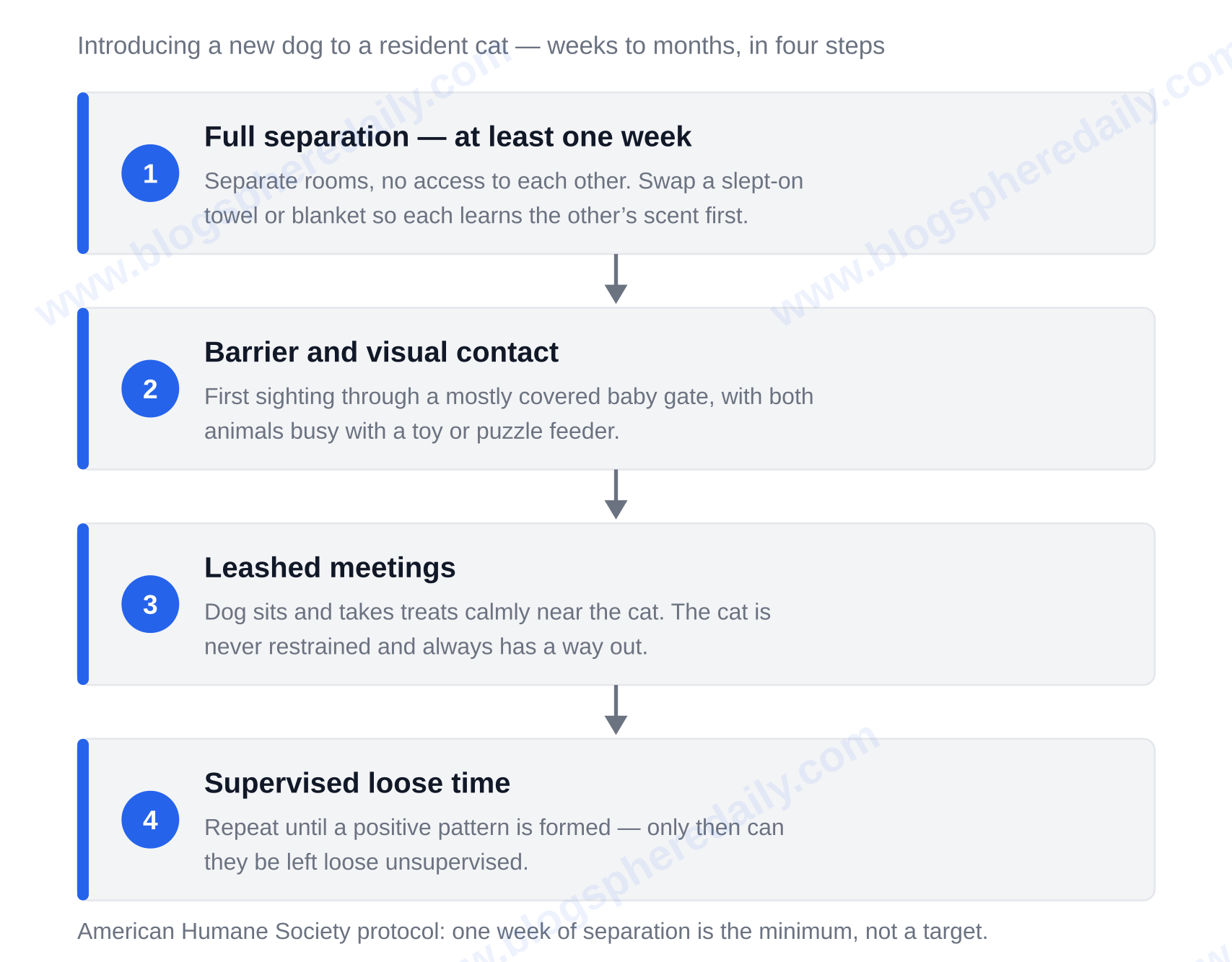
Slowly, over weeks to months, in four steps. The first step of the American Humane Society protocol considers one week to be the minimum, not a target.
- Full separation, at least a week. A full week of full separation in separate rooms with no access to each other, swapping a slept-on towel or blanket to help them get used to each other’s scent before either one ever sees the other.
- Barrier and visual contact. Visual contact is encouraged using a mostly covered baby gate, with both animals busy with a toy or puzzle feeder, to make the first sighting positive.
- Leashed meetings. Dogs must sit and take treats calmly near the cat. Cats are never restrained and always have a way out.
- Supervised loose time. This is repeated until a positive pattern is formed. At this point, they can be left unsupervised.
Setting up the cat’s side of the house
This is the part most guides skip, and it is the part the data says matters most. Before the dog arrives, give the cat:
- Escape routes out of every room, and high perches the dog can’t reach
- A litter box that is inaccessible to the dog
- A feeding station off the floor, separate from the dog’s
- Territory divided into distinct activity areas for sleeping, eating and watching — changes to these areas can themselves impact behavioural problems for the cat
Separate feeding stations are non-negotiable for both animals. Food is the biggest issue when dealing with multiple pets.
Warning signs to stop and back up a stage
- If the dog is stalking the cat, or the dog has a hard, focused look
- If the cat is not eating, or toilets outside the tray
- If the cat is hiding for days rather than hours
- If the cat is hard-staring with flattened ears
- If there is any contact that causes blood to be drawn, STOP immediately
Ask for help if the dog has a high prey drive, if the cat is not improving after a few weeks, or after any real aggression. Your vet, a qualified behaviourist or International Cat Care are good first places to call.
Should you get a dog or a cat?
Look at five criteria: hours at home, home layout, activity level, budget and noise tolerance. Not personality.
Choose a dog if you are home most of the day or can arrange coverage, you want a walking and training partner, you have floor space and tolerant neighbors, and you can spend $1,030 of setup plus four figures each year after that.
Choose a cat if you work out of the house, live in a flat, can offer height instead of space, want a self grooming animal that uses a litter box, and want a lower, flatter, annual cost.
Choose neither yet if no one is home for long periods and you can’t afford to pay for daily care. That’s a real answer and it is probably correct more often than the pet ownership internet is willing to admit.
If you want both, the easier direction is a resident cat meeting a new puppy, or a calm, cat-tested adult dog. The cat gets to own the territory first. And the cat’s comfort is the stronger predictor of success.
Next up is the mix itself. According to AVMA’s own interpretation of the 2026 data, dogs remain the top pet, with cats steadily closing the gap. More homes are going to be debating this exact dilemma and ending up with both. If you’re choosing, see how much setup plus the first full year will really cost for each species. Be honest about your hours at home. If you are adding a second animal, make a calendar appointment for a one-week separation before you bring anyone home, and use that time to set up escape routes, high perches and an out-of-reach litter box first. There’s more to read under Lifestyle.
Common Questions
How long does it take for a dog and cat to get used to each other?
Weeks to months, not days. According to the American Humane Society protocol, it starts with at least a full week of complete separation during which you swap slept-on blankets between their areas, followed by visual contact through a mostly covered baby gate, and then leashed meetings where the dog sits and takes treats near the cat while the cat decides if and when to hang out. Only after a consistent positive pattern is formed should you leave them loose unsupervised. If your cat stops eating, toilets outside the tray or hides for days, back up a stage.
Do cats and dogs understand each other’s body language?
Partly, and where they overlap is where things go wrong. A swishing tail means interest in a dog and agitation in a cat, so each can misread the other’s opening move. A cat’s direct eye contact means threat, but for a dog it means engagement, which is why the cat’s slow blink is its de-escalation signal. Many pairs do learn each other: in the PLOS ONE household survey, 62.4% of households reported their cats and dogs played together, while 68.5% reported their cats and dogs shared a bed together at least occasionally.
Is a cat or a dog cheaper to own?
In nearly all instances, a cat is cheaper, on every available figure. The ASPCA estimated the first-year setup cost, excluding the price of the animal, is $455 for a cat compared to $1,030 for a dog, with the ongoing cost of ownership each year being about $1,149 for a cat and $1,391 for a dog. Diffen’s size-scaled figures run lower overall — roughly $670 a year for a cat, compared to $580 small, $695 medium and $875 large for dogs — but point the same way. Clearly the larger the dog, the larger the expense.