
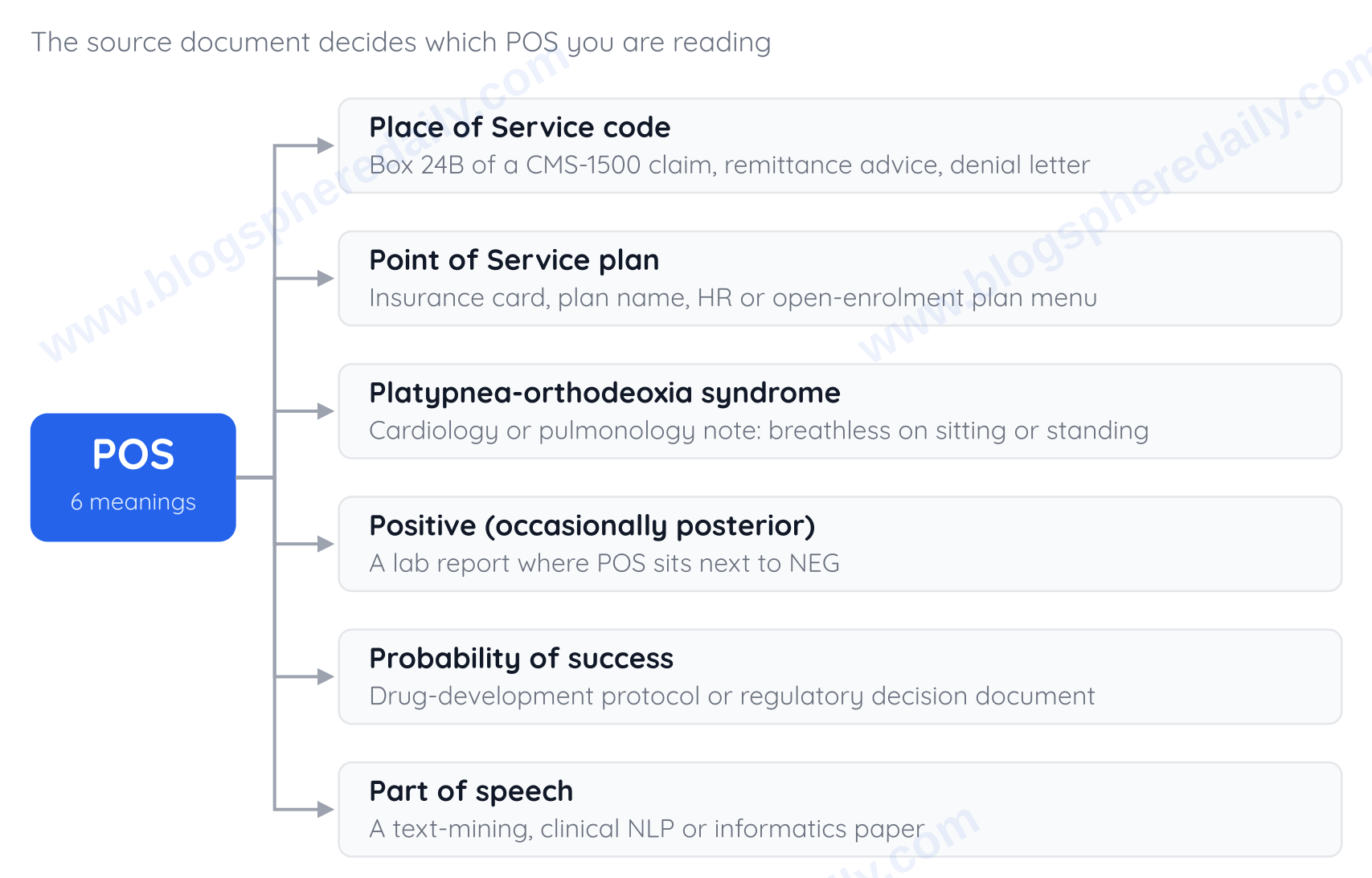
Which meaning of POS you accept depends on which context you find it in. In medical terminology, the meaning of POS is contextual. In billing, POS means Place of Service, which is a two-digit CMS code that describes the location at which the service was delivered. In insurance, POS refers to Point of Service plan. In a clinical note, POS could represent platypnea-orthodeoxia syndrome, positive, or posterior. The source document decides.
Let’s look at a couple examples. For a biller, POS 11 in Box 24B of a claim means “Office,” and for a patient, “POS Plan” on their insurance card means they need a referral to see a specialist. Different meanings for the same three letters, no overlap.
Where Did You See POS? A Routing Table for Every Meaning.
Each resource that ranks for this term is committed to one meaning and leaves the others stranded. Billing resources are committed to Place of Service. Plan resources are committed to Point of Service. Abbreviation resources explain the expansions, but not how to choose between the meanings. Three different groups (billers, patients, clinicians) type the same three letters and need completely different answers.
The “Where You Found It” Decision Table
| Where you saw POS | What it means |
|---|---|
| Box 24B of a CMS-1500 claim, a remittance advice, or a denial letter | Place of Service code |
| An insurance card, a plan name, an open-enrolment benefits menu, or an HR plan comparison | Point of Service plan |
| A cardiology or pulmonology note describing breathlessness that worsens on sitting or standing | Platypnea-orthodeoxia syndrome |
| A lab report where POS sits next to NEG | Positive (occasionally posterior in imaging or anatomy shorthand) |
| A drug-development protocol, portfolio review, or regulatory decision document | Probability of success |
| A medical text-mining, clinical NLP, or informatics paper | Part of speech. |
The rule of thumb: POS with a number is Place of Service; POS with a premium is insurance; and POS with posture and/or saturation is the syndrome.
Abbreviations POS Gets Confused With: POC, PCOS and TOS
- POC — point of care, or plan of care. Different term, different field.
- PCOS — polycystic ovary syndrome. Same letters reordered, entirely unrelated.
- TOS — Type of Service, which sits beside POS on a claim and describes what was done rather than where.
What Does POS Stand For in Medical Billing?
Place of Service (POS) in medical billing means the specific location where the medical service was provided. It’s a standardized, 2-digit, numeric code created and maintained by the Centers for Medicare & Medicaid Services that tells the payer the physical location where a service was delivered. On a CMS-1500 form it sits in Box 24B, one code per service line.
Two details most billing posts skips. First, there are a total of 99 codes, 01–99, however, many of the codes are still undetermined (i.e. “Unassigned”) — so a short list of common codes is not the whole set. Second, version dates exist, and you should check them: the official CMS Place of Service Code Set page carries “Database (updated May 2, 2024)” and a “Page Last Modified: 02/17/2026” stamp. If a code list you found elsewhere shows no date, you can’t tell whether it’s current.
Who Creates and Updates the Place of Service Code List?
CMS owns the list. It’s referenced under the HIPAA Transaction and Code Set standards, which is why payers far beyond Medicare use the same two digits.
POS vs. TOS: Where the Service Happened vs. What It Was
POS is Where; TOS is Type of Service, and they describe two different things. They are separate fields, and often, they are confused and create mix-ups that result in a denial at a later date.
Which Place of Service Codes Come Up Most, and What Do They Pay?
You will see the CMS descriptors for the Place of Service codes the most often as:
| Code | Official descriptor |
|---|---|
| 02 | Telehealth Provided Other than in Patient’s Home |
| 10 | Telehealth Provided in Patient’s Home |
| 11 | Office — a location other than a hospital, skilled nursing facility, military treatment facility, community health centre or State/local public health clinic |
| 12 | Home — a private residence where the patient receives care, other than a hospital or other facility |
| 21 | Inpatient Hospital — a facility other than psychiatric, primarily providing diagnostic, therapeutic and rehabilitation services |
| 22 | On Campus-Outpatient Hospital — a portion of a hospital’s main campus providing those same services to outpatients |
| 23 | Emergency Room – Hospital |
| 31, 32 | Skilled Nursing Facility |
POS 11 vs. POS 22: Office or Hospital Outpatient
Where POS becomes a money field instead of a descriptive field. The code determines whether the facility vs. non-facility reimbursement rate on the Medicare Physician Fee Schedule is paid. For the same CPT code, if you bill POS 11 or POS 22, respectively, then the claim is paid differently. Wrong POS is one of the most common causes of denials, rejections, and post-payment recoupment.
POS 02 vs. POS 10: The Telehealth Codes and the Money Difference
Usually, lists of codes stop after they’ve listed POS 02 and 10 side-by-side as “the telehealth codes.” The part that a biller really needs is that POS 10 triggers the non-facility rate, while POS 02 triggers the lower facility rate. The only difference between the two codes is whether the patient physically sat at home — and that single fact changes what the claim pays.
POS 10 entered the national code set on January 1, 2022, and Medicare recognized it on April 1, 2022, per the CMS MLN Matters instruction. “Home” here covers an owned or rented residence, an apartment, temporary lodging such as a hotel room or short-term rental, and any non-institutional living space.
What Does POS Mean on an Insurance Card or Health Plan?
A POS code refers to a Point of Service plan. According to HealthCare.gov, you will pay less when using providers in the plan’s network. However, you will still need a referral from your primary care doctor to see a specialist. It’s a managed care plan that combines features of HMOs and PPOs, allowing you to self-refer out of the HMO network at a greater cost.
That referral is the thing that actually separates a POS from a PPO, not the vague “hybrid” line most glossaries stop at.
POS Plan vs. HMO vs. PPO vs. EPO
| Plan type | Referral required? | Out-of-network coverage | Premiums |
|---|---|---|---|
| HMO | Yes, from your PCP | Essentially none | Lowest |
| POS | Yes, from your PCP | Covered at higher cost | Moderate |
| PPO | No | Covered | Highest |
| EPO | No | None except emergencies | Mid-range. |
Is a POS Plan Better Than an HMO or a PPO?
Neither is better in the abstract. A POS suits you if you want a care coordinator and the flexibility to use out-of-network providers. A PPO suits you if you self-refer or travel and will pay for the flexibility. The UnitedHealthcare plan-type comparison lays out the differences side by side.
Billers hit this meaning too. A patient’s POS plan governs referral and network rules that create denials entirely separate from Place of Service coding.
What Does POS Mean in a Clinical Note, Lab Report or Research Paper?
Platypnea-Orthodeoxia Syndrome: Definition and Diagnostic Threshold
People with platypnea-orthodeoxia syndrome become dyspneic and desaturate when standing and are symptom free when lying down. Platypnea is dyspnea when moving from the lying to the sitting to the standing position, and orthodeoxia is a drop in the saturation of oxygen in the blood when moving from a lying to a standing position.
Abbreviation lists name the syndrome and leave out the threshold. It is suspected when arterial oxygen pressure falls more than 4 mmHg, or oxygen saturation drops more than 5%, moving from supine to upright. The mixing of deoxygenated venous blood with arterial blood through an intracardiac or extracardiac right-to-left shunt is the most common mechanism in the peer-reviewed literature on cardiac platypnea-orthodeoxia syndrome. A patent foramen ovale is most often the source of the right-to-left shunt.
Does POS Mean Positive on a Lab Result?
Yes, it means positive when it is next to NEG. A positive test means the substance or condition tested for was found, or the measured value is outside the normal range. It is not by itself a diagnosis. POS also turns up occasionally as “posterior” in anatomical and imaging shorthand. See Blog Sphere Daily for other pieces in this vein.
POS in Drug Development and Clinical NLP
- Probability of success — a concept in statistics mostly used by pharmaceutical sponsors and health authorities in support of “go” and “no-go” decisions in drug development and regulatory review.
- Part of speech — in clinical natural language processing, part-of-speech tagging refers to the identification of the syntactic category of each word. You will encounter this meaning only in research papers, not in the clinic.
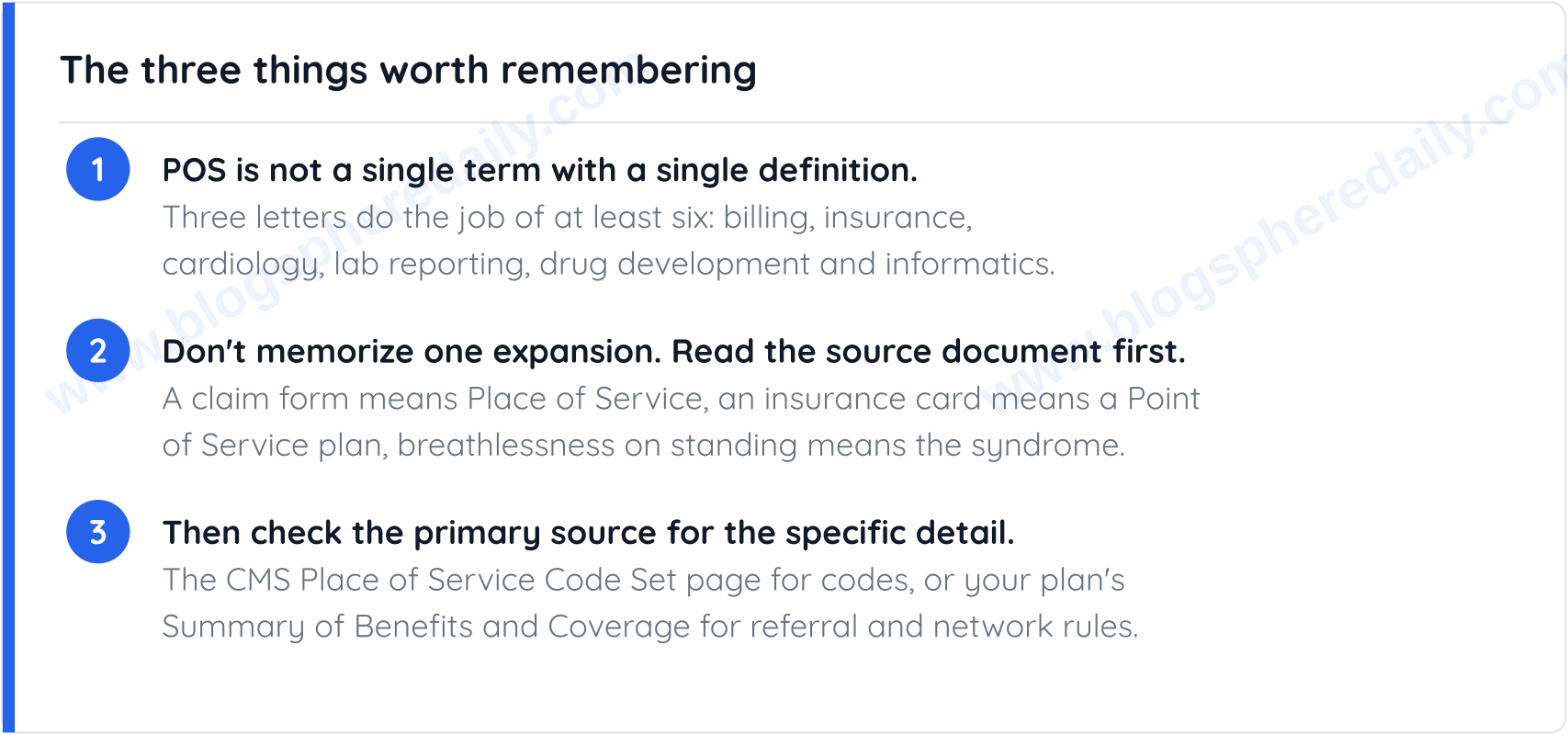
The Three Things Worth Remembering
- POS is not a single term with a single definition. Three letters do the job of at least six in billing, insurance, cardiology, lab reporting, drug development and informatics.
- Don’t memorize a single expansion. Read the source document first. A claim form refers to Place of Service, an insurance card to a Point of Service plan, and a note about breathlessness on standing to platypnea-orthodeoxia syndrome.
- Then check the primary source of the specific detail to be absolutely sure — the CMS Place of Service Code Set page for codes, or your plan’s Summary of Benefits and Coverage for referral and network rules.
Frequently Asked Questions
Where exactly do you put the POS code on a CMS-1500 claim form?
Box 24B, on each service line. The code is entered on a per service line basis rather than once for the whole claim, thus, a claim that covers services rendered in two distinct locations carries a different two-digit code on each respective line.
Can one claim contain more than one POS code?
Yes, since Place of Service is reported on a per service line basis in Box 24B, a single CMS-1500 claim can have a different POS code on different service lines. For example, an office visit coded 11, and a telehealth service on a different line coded 10.
If POS 11 is billed for a service delivered in a hospital outpatient department, what happens?
The claim will likely be denied, rejected or paid and then recouped. POS determines the facility vs. non-facility reimbursement rate under the Medicare Physician Fee Schedule. Coding 11 (Office) rather than 22 (On Campus-Outpatient Hospital) misrepresents the payment basis. Wrong POS is one of the most frequent causes of claim denials and post-payment recoveries.
Does a POS plan cover out-of-network care in an emergency without a referral?
Yes, a POS plan does cover out-of-network providers, at higher cost than in-network ones, and the referral requirement applies to seeing a specialist rather than to emergency care. Because the specifics vary by plan, check your own Summary of Benefits and Coverage for how your plan handles emergency and out-of-network services.