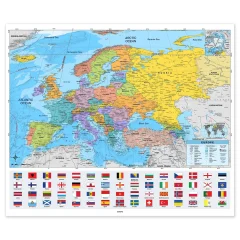
An alliance in WW1 is a formal economic, military or political agreement between two or more nations to support each other in a war or to achieve a shared goal. That is the definition of alliances in WW1 that exams normally ask for, and it is the full alliances definition WW1 answer a marker is looking for. Before 1914, Europe was divided into two blocs: the Triple Alliance (Germany, Austria-Hungary and Italy, 1882) and the Triple Entente (Great Britain, France and Russia, 1907).
A concrete example is the Triple Alliance, signed on 20 May 1882, in which Germany, Austria-Hungary and Italy agreed to provide support if a great power attacked any of them, and in which Italy also agreed to stay neutral in a war between Austria-Hungary and Russia. One document, signed by the named parties, carrying an obligation in writing: that is what the word means in this context.
What most pages skip is that several of the headline pacts were broken, secret, or carried no duty to fight at all. That is the detail that makes the definition actually make sense.
What is the definition of alliances in WW1?
Here is the definition you can lift straight into a short-answer question: an alliance is a formal economic, military or political agreement between two or more nations to support each other in a war or to achieve a shared goal.
Widen this one step further and we get the alliance system of pre-1914 formal agreements between two or more countries. The purpose of this system, as explained by World History Encyclopedia’s account of the pre-WWI alliance system, was to achieve a balance of power, to deter aggression and to maintain peace. It was one of the causes of World War I, but not the whole explanation, and it did not make war inevitable.
The word carries two meanings here, and mixing them up loses points. It can refer to a single agreement, for example the Dual Alliance of 7 October 1879, or to the entire diplomatic architecture the treaties built between 1879 and 1914. The question determines which meaning you need.
Alliance vs entente: why the wording matters
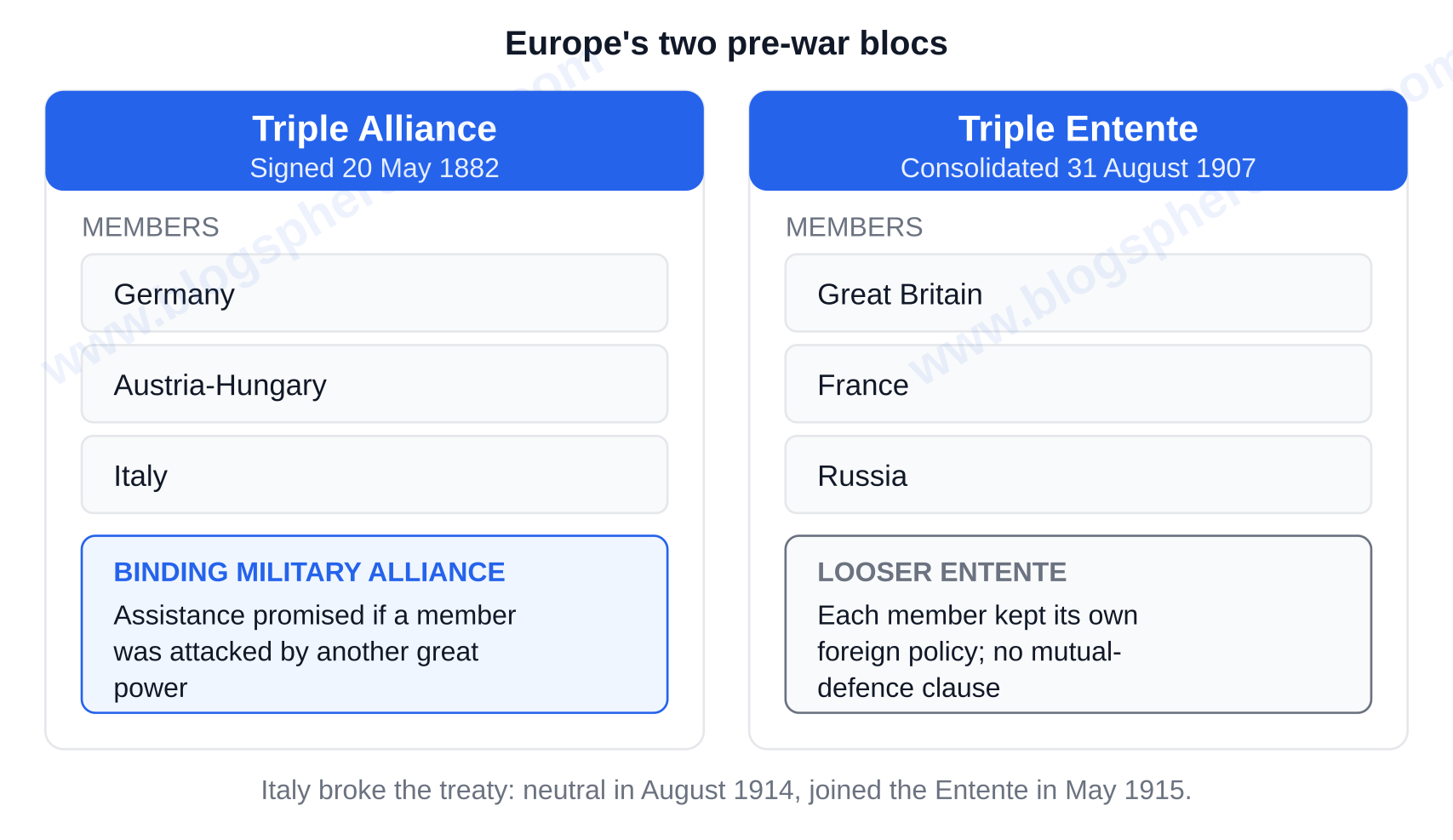
An alliance commits you. An entente is an agreement to coordinate policy, and it is not the same thing as an alliance: in diplomacy an entente lets each member keep running its own foreign policy and carries no mutual-defence clause. That is why the Triple Entente was not an alliance, and why it was looser than the Triple Alliance facing it.
Alliances definition WW1: the “A” in MANIA
In US classrooms the causes of WWI are taught as MANIA: Militarism, Alliances, Nationalism, Imperialism, Assassination. Alliances is the “A”, and the standard worked example is the Triple Entente and the Triple Alliance. It is useful scaffolding, but remember that it is a list of contributing causes, not a ranking.
Which countries were in the Triple Alliance and the Triple Entente?
The Triple Alliance was composed of Germany, Austria-Hungary and Italy. It was a defensive military alliance signed on 20 May 1882, and built upon the Dual Alliance of 7 October 1879 between Germany and Austria-Hungary. It was renewed in February 1887 and June 1902 and expired in 1915 — during the very war it was intended to govern.
The Triple Entente was composed of Great Britain, France and Russia and was consolidated on 31 August 1907. It became the nucleus of the later Allied Powers. It was assembled from three earlier agreements: the Franco-Russian Alliance formalised in 1894, the Anglo-French Entente Cordiale of 1904 and the Anglo-Russian Convention of 1907.
The system was built pact by pact and took nearly thirty years to form:
- Three Emperors’ League — collapsed 1878
- Dual Alliance (Germany, Austria-Hungary) — 7 October 1879
- Triple Alliance (plus Italy) — 20 May 1882
- Franco-Russian Alliance — formalised 1894
- Entente Cordiale (Britain, France) — 1904
- Anglo-Russian Convention — 1907
- Triple Entente — 31 August 1907
Were the WW1 alliances actually binding? The pacts that were broken, secret or optional
This is where the definition of alliances in WW1 that most students are given stops too early. The top results for ‘alliances definition WW1’ name the blocs, state that in 1914 the allies “came to each other’s aid”, and then move on. Put the pacts side by side with their terms and that statement becomes untrue.
| Pact | Date signed | Signatories | Binding mutual defence, or looser understanding? | What actually happened |
|---|---|---|---|---|
| Dual Alliance | 7 October 1879 | Germany, Austria-Hungary | Defensive treaty; the foundation the Triple Alliance was built on | Held — Germany backed Austria-Hungary after Sarajevo |
| Triple Alliance | 20 May 1882 (renewed February 1887 and June 1902; expired 1915) | Germany, Austria-Hungary, Italy | Binding: assistance promised if a member was attacked by another great power; Italy also pledged neutrality in an Austro-Russian war | Broken — Italy proclaimed neutrality in August 1914 and joined the Entente in May 1915 |
| Romania’s adherence to the Triple Alliance | 18 October 1883 | Romania, via King Carol I | Binding on paper, and secret — known only to the King and a handful of senior politicians | Not honoured — Romania ultimately fought against Austria-Hungary |
| Franco-Russian Alliance | Formalised 1894 | France, Russia | Military alliance | Held — Russia mobilised over Serbia, France stood with Russia |
| Entente Cordiale | 1904 | Britain, France | Understanding, not a mutual-defence agreement | No automatic duty to fight; Britain’s entry rested on Belgium |
| Anglo-Russian Convention | 1907 | Britain, Russia | Understanding, not a mutual-defence agreement | Settled colonial friction; created no obligation to go to war |
| Triple Entente | 31 August 1907 | Great Britain, France, Russia | Association in which each member kept its own foreign policy; no mutual-defence clause | All three fought, but Britain cited Belgian neutrality on 4 August 1914, not Entente commitments |
Italy: the ally that promised neutrality to the other side in 1902
Italy broke that promise twelve years before the war started. On 1 November 1902, while still a member of the Triple Alliance and only a few months after renewing it in June 1902, Italy guaranteed France that the two countries would remain neutral if either were attacked. In August 1914, Italy declared neutrality on the grounds that Austria-Hungary was the aggressor. In May 1915, Italy joined the Entente by the Treaty of London. A founding signatory ended up fighting its own allies. The record of the Triple Alliance of 1882 carries the 1902 guarantee and the 1914 declaration. Very few explainers put the two facts together.
Romania: an alliance its own parliament didn’t know about
Romania’s secret adherence of 18 October 1883 is the clearest single piece of evidence that “alliance” in 1914 did not mean what a modern reader assumes. The commitment was in writing, and the country it bound was largely unaware of it. Afterwards, Romania fought against Austria-Hungary anyway.
Britain in 1914: Belgian neutrality, not the Entente
Britain’s entry into the war in 1914 was not an alliance obligation at all. On 29 July 1914 the British cabinet concluded that although Britain had signed the Treaty of London of 1839, its terms did not oblige Britain to oppose a German invasion of Belgium by military force. Britain then entered the war, declaring war on Germany on 4 August 1914, because of a violation of Belgium’s neutrality — not because of an obligation to the Entente.
Put the table and these three cases together and the pattern is clear: the binding pacts were not the famous ones, and the famous ones were broken, secret or optional.
How did alliances cause World War 1?
The ‘official’ version, as taught in textbooks, goes something like this. Gavrilo Princip of the Black Hand assassinates Archduke Franz Ferdinand in Sarajevo on 28 June 1914. Germany issues its ‘blank cheque’ of support to Austria-Hungary. Austria-Hungary sends an ultimatum to Serbia. Russia mobilises for Serbia. Germany declares war on Russia, and then France. Britain enters the war over Belgium. The mutual defence treaties and rigid mobilisation timetables turn a Balkan quarrel into a world war.
The mechanism is correct as far as it goes, but the evidence above limits it. Italy did not honour its treaty. Britain was under no legal obligation either. The key decisions in July and August 1914 were taken on the basis of national interest, not on treaty text.
What the chain-reaction story gets wrong
Mainstream scholarship has moved away from the domino story. Christopher Clark’s The Sleepwalkers (2012) argues that no single power is to blame and that Europe stumbled into a war most of its leaders did not want. The World History Encyclopedia makes the same point more mildly, arguing the system was one of many causes and that it did not make war inevitable.
The balanced position is the one a marker actually rewards. The alliance system heightened tension and widened the war once it began. Earlier crises had been resolved peacefully, and nothing in the pacts made 1914 compulsory.
How did the wartime Central Powers and Allied Powers differ from the pre-war blocs?
Keep these two things apart. The Triple Alliance and the Triple Entente were pre-war diplomatic blocs. The Central Powers and the Allied Powers were the wartime fighting coalitions. Membership is not the same.
The Ottoman Empire joined the Central Powers on 29 October 1914, and Bulgaria on 14 October 1915. On the other side, Japan joined the Allies at the end of August 1914, Italy in May 1915 under the Treaty of London, and the United States in April 1917. Italy, a founding member of the 1882 treaty, never fought alongside Germany and Austria-Hungary at all.
That is the most common mistake on this subject: reading the 1882 line-up as the wartime one. The definition of alliances in WW1 that markers reward is the one that separates a signed pact from who actually showed up.
Terms you are expected to know the meaning of: an entente is an understanding without a defence clause; mobilisation is the call-up and movement of armies to war footing; a casus belli is the stated justification for declaring war; neutrality is a formal refusal to take sides; the balance of power is the equilibrium the pacts were meant to maintain; the Central Powers and the Allied Powers are the wartime coalitions.
Alliances definition WW1: three points to carry into an exam
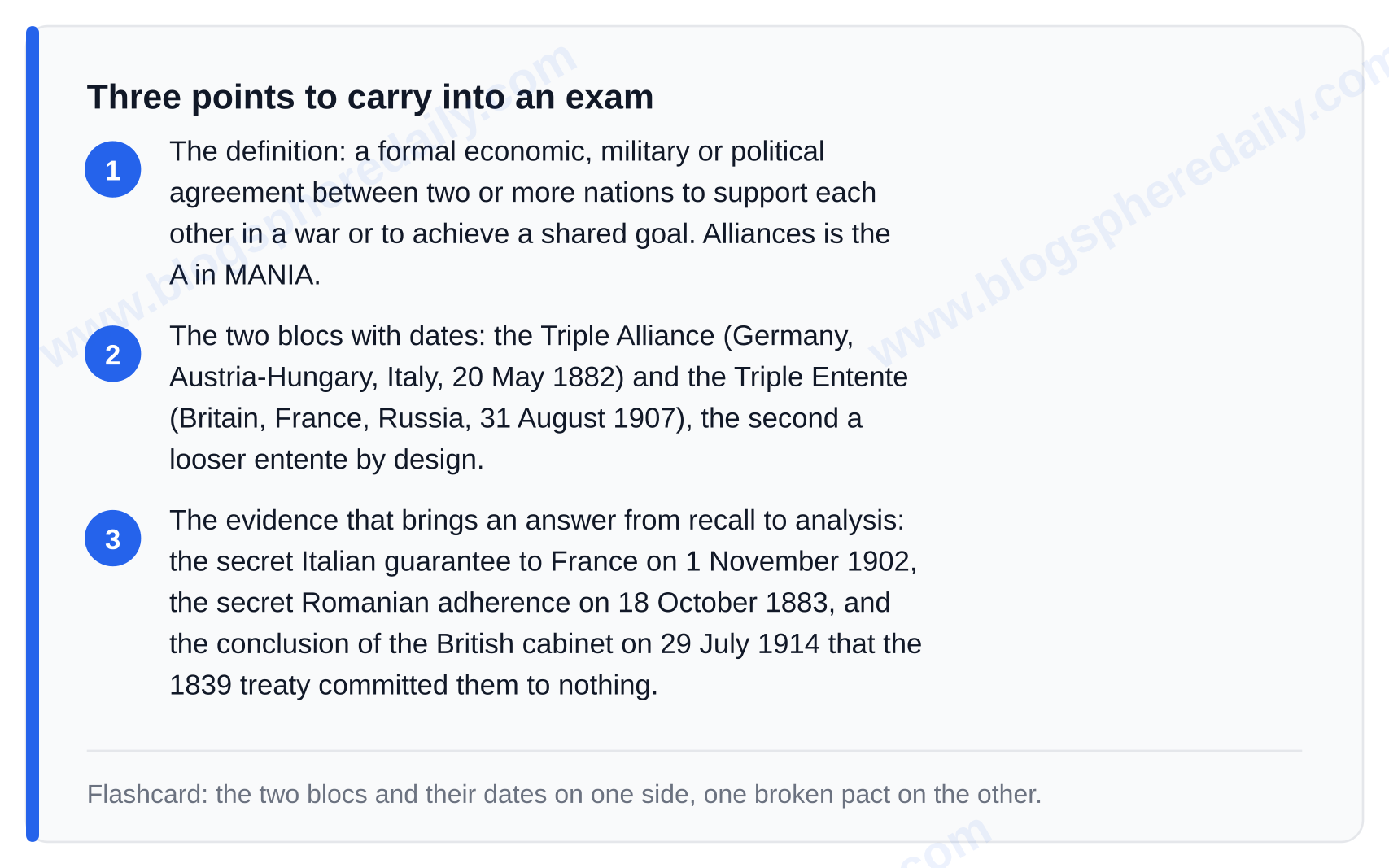
- The definition: a formal economic, military or political agreement between two or more nations to support each other in a war or to achieve a shared goal — Alliances being the “A” in MANIA.
- The two blocs with dates: the Triple Alliance (Germany, Austria-Hungary, Italy, 20 May 1882) and the Triple Entente (Britain, France, Russia, 31 August 1907), the second a looser entente by design.
- The evidence that brings an answer from recall to analysis: the secret Italian guarantee to France on 1 November 1902, the secret Romanian adherence on 18 October 1883, and the conclusion of the British cabinet on 29 July 1914 that the 1839 treaty committed them to nothing.
One flashcard: the two blocs and their dates on one side, one broken pact on the other. Then practise explaining in three sentences how Sarajevo became a European war. For other pieces in this vein, see Blog Sphere Daily.
Frequently Asked Questions
What is the simple definition of alliances in WW1?
Alliances in World War I were formal economic, military or political agreements between two or more countries to support each other in a war or to achieve a shared goal. The two principal examples are the Triple Alliance of Germany, Austria-Hungary and Italy, signed on 20 May 1882, and the Triple Entente of Great Britain, France and Russia, consolidated on 31 August 1907.
What does ‘entente’ mean, and is an entente the same as an alliance?
No. An entente means an understanding rather than a commitment: in diplomacy it lets each member keep running its own foreign policy and is not a mutual-defence agreement. Therefore the Triple Entente was an entente and not an alliance — it was deliberately looser than the Triple Alliance facing it, and it carried no automatic duty to go to war.
Why did Italy leave the Triple Alliance and join the other side?
Italy had been hedging for years. On 1 November 1902 it secretly guaranteed France that each would stay neutral if the other were attacked, months after renewing the Triple Alliance in June 1902. In August 1914 Italy declared neutrality, explaining that Austria-Hungary was the aggressor, and in May 1915 it joined the Entente through the Treaty of London.
Were the alliances of 1914 secret, and did countries have to honour them?
Some were secret and not all were honoured. Romania secretly adhered to the Triple Alliance on 18 October 1883 through King Carol I, with only the King and a few senior politicians aware of it, and Romania ultimately fought against Austria-Hungary. Italy broke its treaty outright. And on 29 July 1914 the British cabinet concluded the 1839 Treaty of London did not oblige Britain to resist a German invasion of Belgium by force.
What does the A stand for in the MANIA causes of WW1?
The A means Alliances. MANIA stands for Militarism, Alliances, Nationalism, Imperialism and Assassination, and the Alliances strand covers the pre-1914 agreements between nations to help each other during a conflict — usually illustrated with the Triple Alliance and the Triple Entente. It is one contributing cause among several, not a ranking of blame.
Which alliance was the strongest before 1914, the Triple Alliance or the Triple Entente?
On paper the Triple Alliance was stronger, because it was a binding defensive treaty in which each member promised assistance if attacked by another great power. The Triple Entente was an association without a mutual-defence clause. In practice the paper strength misled: Italy declared neutrality in August 1914 and switched sides in May 1915, while all three Entente members fought.