
Most people think of detachment as caring less. It actually means caring less about the way things turn out. This misunderstanding is the reason the practice fails for most people. The law of detachment is best expressed in the popularised form of Deepak Chopra’s sixth spiritual law, which says that we should work, dream, and act with full commitment and without forcing the result — keep the desire, keep the intention, keep acting, and release your grip on one exact outcome arriving in one exact form.
While I have been editing this topic for many years, and have wanted to acknowledge the places where I part ways with the pages that rank for it, I have been honest about the things that are left unsaid on almost every page. Two of these are far more important than yet another list of affirmations.
What is the law of detachment in simple terms?
You have a desire. You set an intention. You take action. You then let go of the specific way it needs to happen, through which person, at what time.
That is the essence of the practice. Being attached does not mean caring. Being attached means that you are requiring (insisting) a particular outcome, in a particular way as the only means for you to be okay. The insisting is what you let go of, not the caring.
Chopra’s sixth spiritual law, in his own words
Chopra’s writing in The Seven Spiritual Laws of Success is worth quoting word for word, because paraphrasing it drifts. “In order to acquire anything in the physical universe, you have to relinquish your attachment to it. This doesn’t mean that you give up the intention to create your desire. You don’t give up the intention, and you don’t give up the desire. You give up your attachment to the result.”
Chopra attaches three commitments to it: allow yourself and others the freedom to be who they are; refrain from forcing solutions so solutions can emerge on their own; and treat uncertainty as essential. He calls uncertainty the “path to freedom” rather than a problem to solve. He calls detachment synonymous with wealth consciousness because detachment frees one to create.
One phrase, two unrelated meanings
The same three words name a rule of deductive reasoning taught in geometry: if P leads to Q and P is true, then Q is true. If you came to this page from a math class, skip to the logic section near the end, because the ideas presented are unrelated, and no spiritual page I checked mentions this, which is why half the people searching this phrase end up somewhere useless.
What detachment is not: indifference, giving up, or suppression
The misinterpretations are understandable, so I will include them side-by-side:
- Attachment: “It has to be him.” “It has to be that job.”
- Detachment: “I want a partner like this, and I’m open to who shows up.”
- Indifference: “I don’t want anyone.”
Detachment is the middle of the three, and is the only one that keeps the desire intact. It is not giving up. The effort is still there, just the white-knuckling goes. It is not coldness either. You can be completely warm toward someone and completely unattached to how they respond this week. It is also not suppression, which is a different mechanism that has a different outcome. More on that below, because it is the one failure mode that actually hurts people.

The two things the top results get wrong
The first is the disambiguation above. Page one for this phrase mixes spiritual explainers with a geometry lesson, and not a single spirituality page acknowledges the other meaning exists.
The second is bigger. “Letting go lowers stress” is asserted on every ranking page with no evidence. One-page touches on quantum physics and cites nothing at all. So here is the honest version.
What the research actually measured — and what it didn’t
Säfström and Hartig (2013) measured psychological detachment in 173 Uppsala University students (age 20–30) with the Recovery Experience Questionnaire developed by Sonnentag and Fritz, using a subscale with four items (α = 0.88). In their published findings, detachment partially mediated the path between demands and perceived stress (95% CI 0.0247–0.1749) and fully mediated the path between demands and life satisfaction. Detachment did not mediate the path between demands and cognitive failures at all, and it did not moderate any of the relationships tested.
Then, the line that undermines the whole genre. The authors concluded that detachment is “less an individual capability than a variable sensitive to the imposition of demands.” Once more if you’ve ever been instructed to just release it. If your burden is genuinely crushing you, detachment is not a switch you choose to activate, your capacity to detach is, to a degree, a function of the burden itself.
My opinion: This is a legitimate effect with clear constraints. You can expect support for alleviating felt stress and improving life satisfaction. You can not expect this to help you with dealing with work-related concentration issues or an exhausting and/or heavy workload. A newer peer-reviewed study, assessing self-compassion as a moderator between low detachment and depressive symptoms, hints at what you tell yourself when you fail to detach as being equally important. No competitor touches either finding.
Why attachment backfires, and why letting go is hard
There is a behavioural explanation here, not a mystical one. Gripping to an outcome creates behaviour around control: checking, chasing, over-asking, renegotiating. Those behaviours are the actual cost. This is where desperation drives how you text, how you interview, how you negotiate, and generally how you interact with the world — and trust changes all three in the opposite direction. Attachment also narrows your field of vision. Being single-mindedly focused on one job, one person, one timeline makes you miss the better-fitting option sitting in your peripheral vision.
On the individual level, holding on tight feels like anxious attachment, rumination and hypervigilance. All three are exhausting to sustain, which is the point Chopra makes in reverse: refusing to force a solution is what lets a solution emerge.
So why is releasing so hard? Uncertainty is interpreted as risk by the human mind, so the mind substitutes a fixed outcome for safety. Gripping also creates the illusion of progress, which is why doing nothing to solve the outcome feels counterintuitive. If you believe there is only one chance, letting go feels like self-sabotage. And the longer you have wanted it, the more releasing it feels like admitting the wanting was wasted. Keep the research caveat in mind. If the demands on you are high, struggling to detach is situational, not a character flaw.
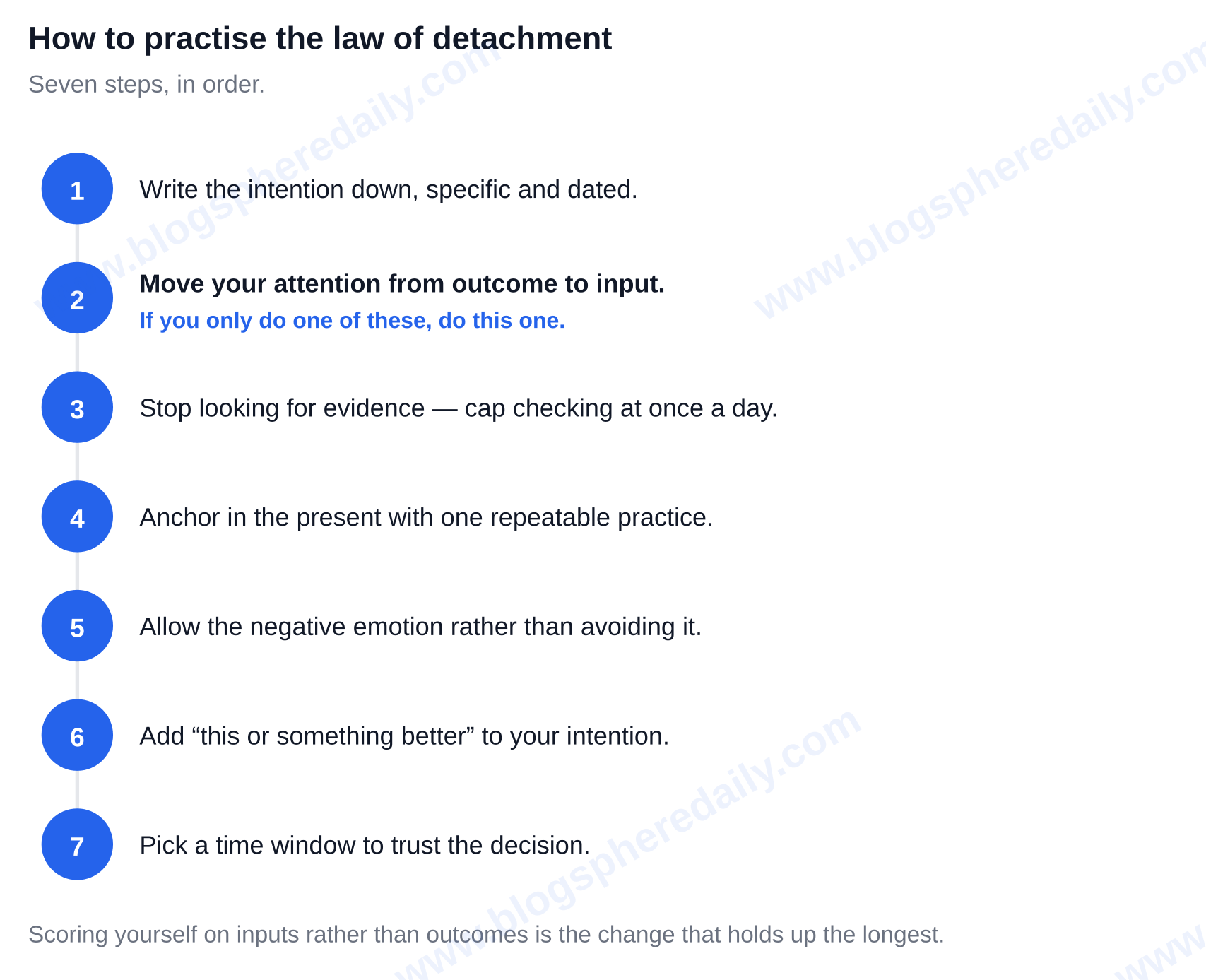
How to practise the law of detachment: 7 steps
- Write the intention down, specific and dated. Detachment without an intention is just drifted.
- Move your attention from outcome to input. Define the daily action you control — applications sent, reps done, conversations had — and score yourself on that only.
- Stop looking for evidence. Label your checking behaviour (i.e. inbox refreshing, thread re-reading, number re-pulling) and cap it at once a day.
- Anchor in the present with one repeatable practice. Breath, walk, or other body-based reset, used the moment the grip tightens, not as a schedule.
- Allow the negative emotion rather than trying to avoid it. Let the disappointment arrive, name it, let it move through. Feeling it is detaching, not a failure of it.
- Add “this or something better” to your intention. With this minor tweak, a different outcome now means a win rather than a loss.
- Pick a time window to trust the decision. This is basically setting a time limit on relitigating the decision. That is how you stop forcing long enough for something to emerge.
If you only do one of these things, do the second. Scoring yourself on inputs rather than outcomes is the highest leveragable change on the list and the one that holds up the longest.
Detachment in relationships and in manifestation
This is most noticeable in the way we love. It means being able to love without emotional dependency: staying warm while your sense of being okay stops depending on how the other person behaved this week. It means holding boundaries, no matter what the person says — boundaries are detachment made concrete, and you can hold a limit without needing the other person to agree with it. Releasing attachment to a specific person means you want to connect with this person while dropping the demand that they be the only possible source of it. “Manifest a specific person” is a collapse in the face of free choice. It is the case that free will always remains and enters the picture.
In the case of the law of attraction, the sequence is intention, then release: set it clearly, act, then stop auditing reality for proof. Obsessive checking is attachment wearing the costume of effort. This is also where “this or something better” earns its keep, because the grip is usually in wanting or striving for a very narrow outcome.
Is it working, or has it become avoidance?
Signs it is working: the outcome still matters but no longer hijacks your day, you can hear bad news without reorganising your identity, you are still taking action, and other parts of your life have oxygen again.
Signs you have stalled: the checking stopped but so did the wanting. You feel flat rather than free. The subject has quietly become unmentionable.
The clinical distinction tips the balance. Intentional detachment reduces your emotional investment in something that is harming you while you still feel and process the emotions that come with the decision. Emotional avoidance, as Grow Therapy’s clinicians point out, is unconscious suppression or numbing to escape the discomfort without working through what sits underneath. This may bring temporary relief, but the feelings reemerge later, in subsequent relationships, and may even manifest physically.
Let’s do a quick check on yourself. Are you able to identify the feelings you have about what you are detaching from? Can you name it? If the answer is no, “release the outcome” is not the instruction for you right now. It is time to process. This can look like journalling, talking it out, or seeking the help of a therapist. The same is true for someone who is trying to avoid a conversation they already know they need to have by using detachment language.
Where the idea comes from
The concept of non-attachment is found in several Indian schools of philosophy and religion, and is not a self-help invention. The idea of framing this as a law, the success application, and the phrase itself are relatively recent. Here’s where the recent and the old ideas overlap:
| Tradition / source | Core term | What you release | What you keep |
|---|---|---|---|
| Chopra, 1994 — sixth spiritual law | Detachment | Attachment to the result | The intention and the desire; uncertainty as the path to freedom |
| Bhagavad Gita — karma yoga | Nishkama karma | Attachment to the fruit of the action, and being swayed by success or failure | The duty and the action itself |
| Buddhism — dependent origination | Taṇhā (craving) → upādāna (grasping) | The active grasping that follows craving | Non-attachment, virāga, as the practice |
The Buddhist term is the most precise of the three. Upādāna is literally fueled, or that which keeps a process burning, like a fire. Craving is the first thirst; upādāna is the grasping which sustains it.
What is the law of detachment in geometry and logic?
Different idea, same three words. In geometry and logic, the law of detachment is a type of reasoning where if P leads to Q and P is true, then Q is also true. Logicians call it modus ponens, also known as modus ponendo ponens — “the mode that by affirming, affirms.”
Example: If it is raining, then the match is cancelled. It is raining. Therefore the match is cancelled.
There are two places students normally make mistakes. First, for the reasoning to be valid, both the conditional and the hypothesis must be true, and affirming the conclusion to prove the hypothesis is a different and invalid move. Second, the law of detachment should not be confused with the law of syllogism, which is normally presented with it. The law of syllogism chains two conditionals — from P → Q and Q → R, it is also true that P → R — rather than detaching a conclusion from a true hypothesis.
Lastly, and to be clear, as no other source on this topic says this, the law of detachment has nothing to do with the spiritual principle of the same name beyond the shared name.
The honest bottom line
Narrower than it seems. Keep the desire, the intention, and the action. Release the demand it takes a particular shape. The research supports a real and bounded impact on felt stress and life satisfaction, and it is honest enough to acknowledge that detachment is actually sensitive to your actual load, rather than a switch you can turn on/off at your will. If you’re currently numbing, it’s processing, not this practice. If you can still name what you feel, it’s this practice.
Next step, today: Identify the one outcome you are currently gripping, write your intention in a single sentence, define the daily input you control, and cap your checking to once a day for the next week. You’ll find related pieces under Lifestyle.