“Halal” is the Arabic term meaning “lawful” or “permissible” under Islamic law. When referring to food, the halal food meaning is that a product or its components — and the way it was produced — are “lawful” or “permissible” for consumption by Muslims: pork-free, alcohol-free, and, for meat, slaughtered by the dhabihah method. The opposite of halal is haram. Haram means “prohibited.”
An example: Tomato pasta sauce is halal, without a certification to prove it, because nothing in it is prohibited. A beef burger is not halal just because it is beef. It all depends on how the beef was slaughtered, who slaughtered it, and what was said over the animal.
What does halal food mean in plain English?
The root of the word halal, ḥ-l-l carries the meaning of lawful or released. The root of haram, ḥ-r-m carries the meaning of forbidden or set apart. The two roots, and therefore the two terms, always come as a pair, which is why you rarely see one explained without the other.
The general principle regarding Islamic law is the part readers are usually not told: things are lawful by default. In other words, things don’t need a certificate to be declared permissible — they need a prohibition to be banned. As The Conversation’s explainer by scholars M. Obaidul Hamid and Md Mahmudul Hasan notes, in the words of scholar Yusuf Qaradawi, halal is that “which is permitted, with respect to which no restriction exists”. So the shorter list is always the forbidden one.
Two more things to get straight early. Halal is more than just a term for food. It applies to all aspects of life (e.g. finance, trade, travel, etc.) — food is simply where most people meet it. There is nothing to restrict non-Muslims from eating halal food. Anybody can consume halal food. A halal label describes how the food was made, not who is allowed to buy it.
Quran and Sunnah are the main sources of Islam, and Shari’ah is the reference point for all rulings. A logo of the certifying body does not create the ruling. It only claims the product meets the ruling.
Halal vs. haram: the two words that do most of the work
Halal means you may. Haram means you may not. Halal and haram are the two main terms in this article. So what lies between halal and haram? More than most explainers will tell you.
Where does the word ‘halal’ come from — and when did English take it?
The word ‘halal’ was used to describe a legal ruling for centuries before it described food on a packet. It travelled into English through translation and travel writing, not through food commerce, which is why its earliest English uses describe a concept in general rather than a product.
Now the truth (and the date). The reference books do not agree:
- Oxford English Dictionary: earliest English evidence from 1797, in a translation by Robert Heron.
- Dictionary.com: first attested 1795–1800.
- Etymonline: 1858.
- Oxford Learner’s Dictionaries: “mid 19th century”, no year specified.
There is, of course, a 60-year spread across the four standard sources, so a reader asking “how old is the English word?” currently has to go dictionary-shopping and will come back with four answers. Present the spread rather than pick a winner. Worth knowing too: the OED entry for halal sits behind a paywall, making the 1797 citation the most challenging of the four to find for free.
Which foods are halal and which are haram?
By default, halal foods include fruits, vegetables, grains, rice, pasta, bread, pulses and dairy. Beef, lamb, goat and poultry become halal with proper slaughter.
Haram foods include all pork and all pork products, all alcohol and other intoxicating substances, flowing blood, carrion, animals that have been killed by an agent of death including strangling, injury, goring or predation, animals that have been slaughtered improperly, and meat offered to idols. The Quran explicitly identifies thirteen prohibited items — including hunting while in a state of Ihram — therefore the list is longer than the “pork and alcohol” rule states.
The thing that trips people up the most is the ingredient list, because ingredients can be hidden in many foods and many additives or processing aids: gelatin in sweets and capsules, animal-derived rennet and enzymes in cheese, emulsifiers such as E471, and flavourings carrying ethyl alcohol. Preparation of the food can affect its status as well. Even the grills and fryers that food is cooked on can render the food haram if they are shared with pork, and the same thing can happen with shared utensils and cutting boards, alcohol in sauces, marinades and glazes, or any failure to separate from pork across the kitchen and the supply chain.
The grey area: is seafood and shellfish halal?
The standard food list fails many readers with its silence on seafood. Most explainers put “fish, shellfish” in the allowed category with no explanation. The Shafi’i, Maliki, and Hanbali Schools of law generally permit seafood with reference to Quran 5:96.
The Hanafi School generally does not. It permits true fish and treats other seafood as forbidden or makruh — discouraged. Hanafi Scholars argue on prawns and shrimp as to whether they are fish, while most agree crab, lobster, mollusks and crocodile are not permitted.
The standard food list has blunt consequences. Many Hanafi readers of a typical top-result food list may be eating something that their school of thought (madhhab) discourages. The question “Is shellfish halal?” does not have a school-neutral answer.
How is halal meat slaughtered?
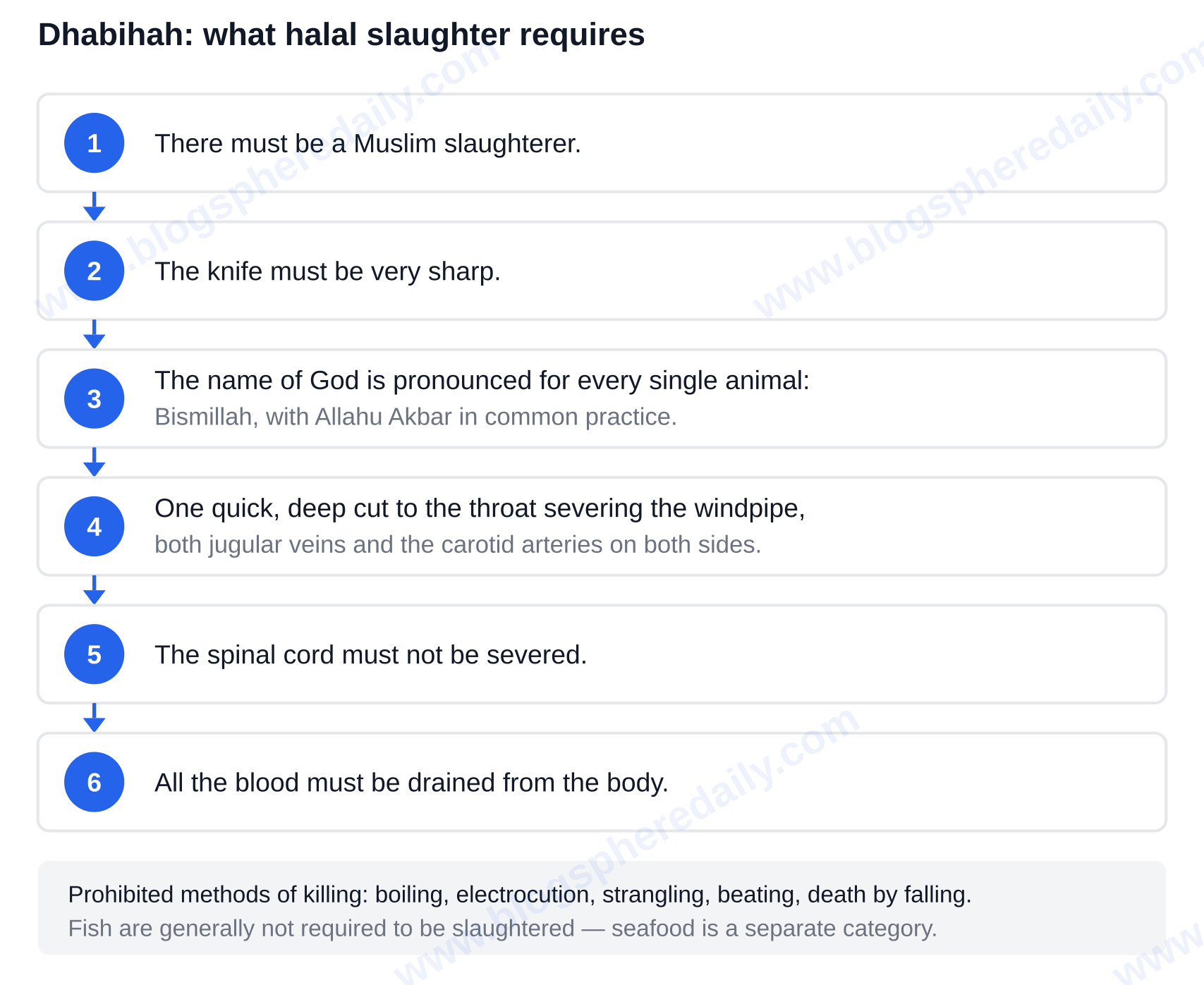
In order for meat to be halal, it must be slaughtered in a certain way, called dhabihah or zabiha. It is specific, not vague. There must be a Muslim slaughterer. The knife must be very sharp. The cut has to be done quickly and deeply to the throat to sever the windpipe and both jugular veins along with the carotid arteries on both sides. The spinal cord must not be severed. All the blood must be drained from the body. Among the prohibited methods of killing are boiling, electrocution, strangling, beating and death by falling.
The invocation must be made — it is a requirement, not a flourish. The name of God is to be pronounced for every single animal to be slaughtered, Bismillah, with Allahu Akbar in common practice. Fish are generally not required to be slaughtered. Seafood is in a separate category from meat.
There is also the issue of definition pages skipping: can the animal be stunned prior to cut? The certifiers themselves are split on this. The Halal Monitoring Committee (HMC) in the UK only certifies non-stunned meat, and requires documented evidence to show that the animal survived any stun and was alive at the time of slaughter. The Halal Food Authority (HFA) accept electrical stuns of the type that are reversible in principle.
There is also uncertainty regarding how much of the total UK halal meat is non-stunned. Published figures do not agree. The article on Halal in Wikipedia states that approximately 16% of all halal-slaughtered animals are not pre-stunned. The Halal Times states that approximately 30% of all sheep slaughtered under halal in the UK are non-stunned. A 2020 ruling in the EU adds live legal pressure, holding that member states can restrict religious slaughter on animal welfare grounds.
Given all the above, it is important to note that two packs can both carry a halal logo and mean materially different things.
Halal, makruh, mashbooh, haram: what do you do with a doubtful ingredient?
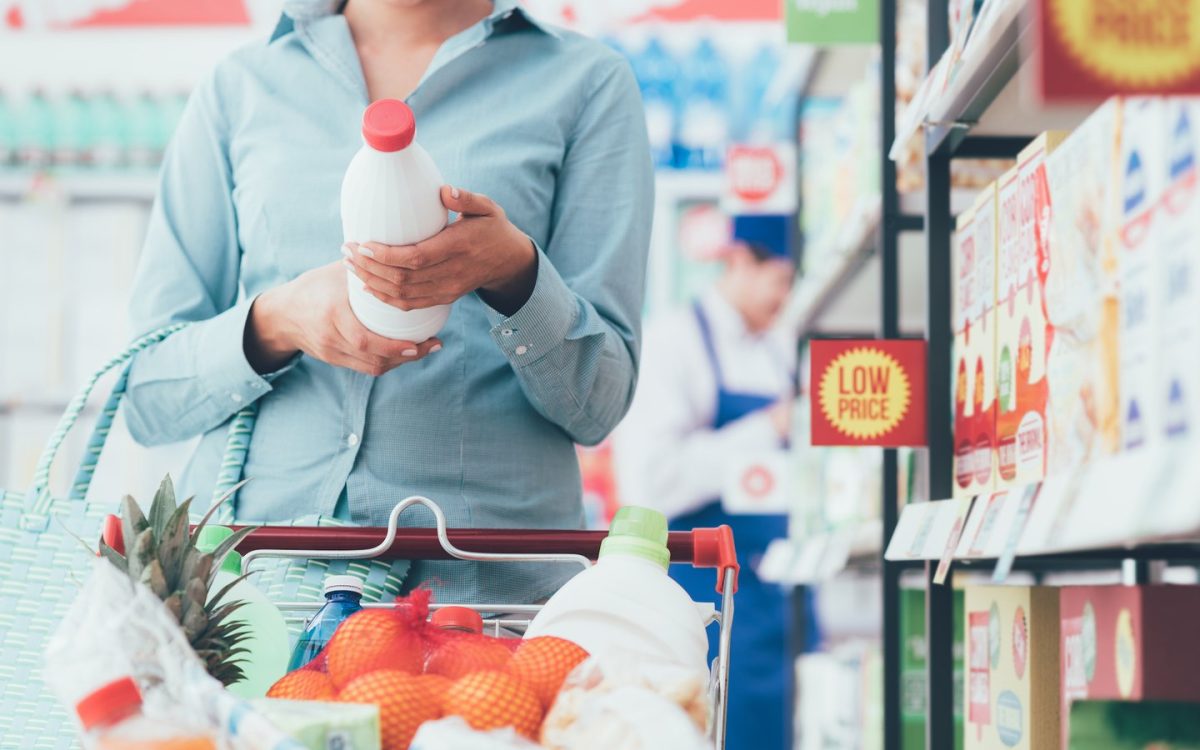
Halal is routinely presented as an on/off switch, and that framing is exactly what leaves a shopper stranded in the aisle holding a packet they cannot classify. There are reasons to support the use of all four categories in practice — Al-Halal (lawful), Al-Haram (unlawful), Al-Makrooh (discouraged) and Al-Mash-booh (doubtful) — and virtually all explanations include all four. Almost none attach an example to the middle two, and the middle two, particularly the Al-Mash-booh category, cover the actual real world supermarket decisions.
| Category | What it means | Recognisable example | What to do |
|---|---|---|---|
| Halal | Clearly permitted | Certified pasta sauce | Eat it |
| Makruh | Discouraged, not sinful | Crustaceans for a Hanafi reader | Avoid if you follow that school |
| Mashbooh | Status cannot be confirmed | E471 on a biscuit wrapper, gelatin sweets, fast-food chicken from a shared fryer, dairy with undeclared enzymes | Check the source before deciding |
| Haram | Prohibited | Pork gelatin, wine vinegar in a marinade | Do not consume |
This rule is typically left out by ranking pages: mashbooh is not haram. It means that the halal status of an ingredient cannot be confirmed, and further investigation is needed to understand its origin.
E471 — mono- and diglycerides of fatty acids — is used as an example, and is probably the most common mashbooh additive for a simple reason. It can be of animal or vegetable origin and the label does not disclose it. The additive number is the same either way. So the next step is not a guess. Contact the manufacturer, check the certifier’s standard, or substitute.
Why the clean binary breaks down
The binary breaks down because Islamic jurisprudence has never really embraced one. It elaborates halal and haram into the five decisions: fard (mandatory), mustahabb (recommended), mubah (neutral), makruh (reprehensible) and haram (forbidden). Scholars have had genuine disagreements on whether “halal” covers only the first two categories or the first four.
Because of this unresolved scope, you’ve probably noticed flexing on packaging. A word with a contested scope can stretch, and that is how one Quranic ruling category now legitimately reaches soap, finance and holidays.
What does halal mean beyond food — and what does certification actually prove?
Outside the kitchen, halal now includes Islamic finance and the prohibition of riba (interest), personal care and cosmetics, pharmaceuticals formulated to avoid animal-derived gelatin, tourism, and logistics and packaging.
Certification audits cover more than a recipe. A reliable body assesses the sourcing of ingredients, the method of slaughter, the storage, the transportation and how the product is separated from haram materials in the entire supply chain. Standards and bodies differ by countries, and so do the authorities: in Muslim-majority countries, the government authority manages it, whereas elsewhere, non-governmental bodies manage it. In the UK, these bodies are HMC and HFA, and in the US, it’s Halal Monitoring Services (Chicago), the Halal Food Standards Alliance of America (Oakland), and Halal Watch World (New York). A logo therefore answers one question: who vouched for this against which standard? Read the certifier, don’t just look at the symbol.
Is halal the same as kosher?
Both are similar and different in various aspects:
- They are alike in the fact that both require ritual slaughter by a qualified person — but halal slaughter is performed by a practising Muslim reciting the Basmala, while kosher slaughter is performed by a trained shochet.
- In kosher, it is forbidden to consume any dairy products along with meat. In halal, any products can be consumed together.
- Halal permits seafood more broadly than kosher.
- In kosher, some alcohol is permitted. In halal, any sort of intoxicants are forbidden outright.
For caterers and shoppers, the conclusion is practical: kosher certification is not a substitute for halal certification, and vice versa.
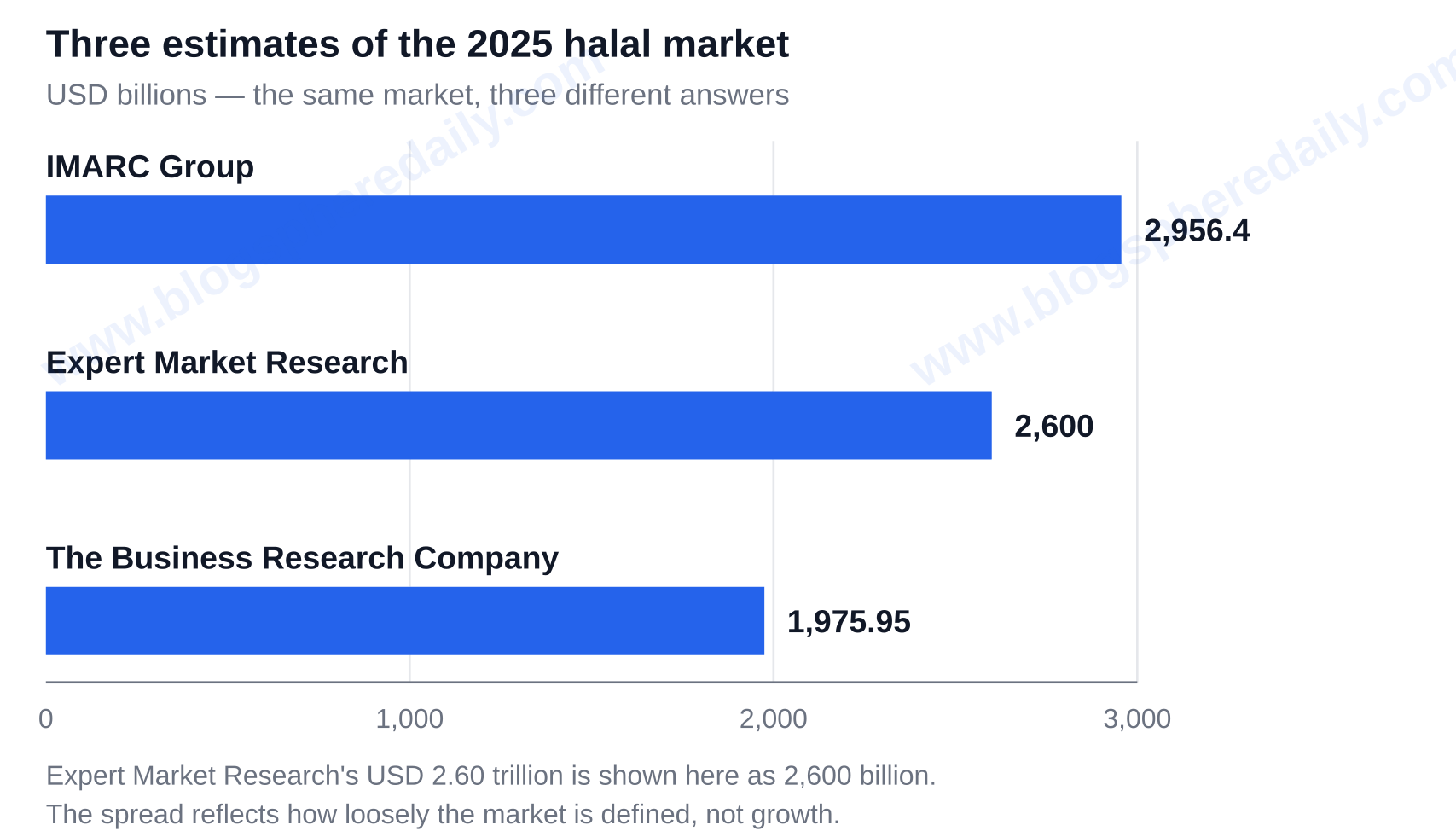
As for how far the label has extended, the market research estimates vary and disagree. IMARC Group puts 2025 at USD 2,956.4 billion, Expert Market Research at USD 2.60 trillion, and The Business Research Company at USD 1,975.95 billion. The difference in the estimates shows the lack of precision in defining the market.
The one line to remember
Halal means permissible under Islamic law and haram means forbidden. What the top results leave out is that the judgement is graded, not switched. This is why there are shades of permissibility – makruh and mashbooh. This is also why two halal logos can mean different things. So if you came here about one specific item, go and find its certifier or its ingredient source and check that.
As a general rule, halal is a claim about how something was made — so when in doubt, check the source, not the sticker. There’s a lot of information available on Blog Sphere Daily.