You get a notice on Tuesday: your Dallas location closes in 60 days. The first thing to know is that there is no Texas WARN Act. Texas has no mini version of the WARN Act, so the federal WARN Act of 1988 controls: employers with 100 or more full-time employees have to give 60 calendar days’ written notice of a qualifying plant closing or mass layoff.
This guide addresses the entire process in order. The first question is whether the federal law applies to your situation at all, what is the content of the notice, where do Texas employers send notices, how do the 60 days’ notice get reduced to less, what do workers get if they don’t get notice, and what is the deadline for employee’s last paycheck in Texas.
Is there a Texas WARN Act, or does federal law cover Texas layoffs?
There is no state act to cover Texas layoffs. The phrase is a shorthand for the federal Worker Adjustment and Retraining Notification Act (WARN Act) for Texas layoffs. Unlike California, New York, or New Jersey, Texas does not have a mini-WARN Act, which results in three consequences: no extra notice days, no reduction in the employee threshold, and no state penalty layer stacked on the federal one.
The relevant laws and regulations are in the Worker Adjustment and Retraining Notification Act of 1988, 20 CFR Part 639, and the regulations administered by the U.S. Department of Labor’s Employment and Training Administration. Everything else in this guide is a consequence of those two documents, not of anything the Texas Legislature passed.
Consider the baseline, too. Texas is an at-will employment state. WARN is a narrow exception to the rule — not a general right to advance warning — and absent WARN, a written contract, or a union agreement, your Texas employer can terminate your employment today with no notice whatsoever.
The Texas Workforce Commission’s role is smaller than what most people presume. TWC is the state dislocated worker unit and receives WARN notices. TWC does not enforce the Act and has no authority to find an employer that did not give notice.
Before you lean on any of this in a dispute: mini-WARN bills surface from time to time in various state legislatures. As of this writing, nothing suggests that Texas has passed such a bill, but confirm the state of the law if real money turns on it.
Does the WARN Act apply to your Texas layoff? Run the two tests in order
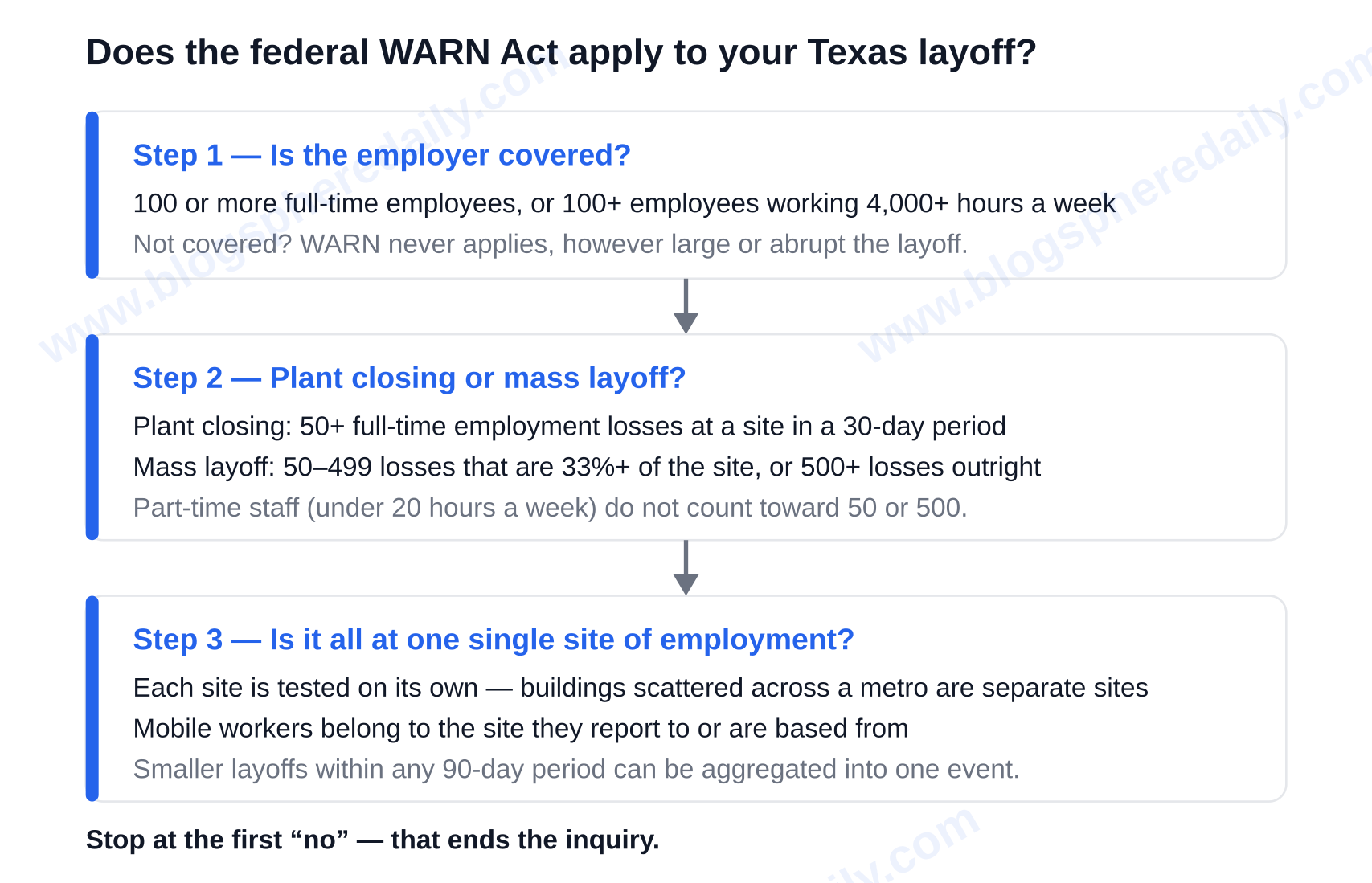
People search for the Texas WARN Act when what they really want to know is “did my layoff require notice?” Competing explainers scatter the thresholds across four paragraphs. This is why the same questions get asked repeatedly. Sequence the tests, and stop at the first “no” — that ends the inquiry.
Step 1: Is the employer covered?
A covered employer is one with 100 or more full-time employees, or with 100 or more employees who work a combined total of at least 4,000 hours per week, excluding overtime. Unless the employer is covered by WARN, the act never applies — no matter how large or abrupt the layoff is, and no matter how many people lose their jobs on the same day. Most layoffs in Texas that appear to be WARN events fail at this first step.
Step 2: Does the layoff count as a plant closing or mass layoff?
The WARN regulations define two triggering events. A plant closing is the shut down of a single site, or an operating unit within it, that results in employment loss for 50 or more full-time employees in a 30-day period. A mass layoff is the termination of employment of 50 to 499 full-time employees who make up at least 33% of the active workforce at that site. It is also a mass layoff if the employer terminates 500 or more full-time employees regardless of percentage of the active workforce.
A carve-out that quietly decides large layoffs in Texas retail and food service: part-time employees do not count for the 50 or 500 threshold. Regulations provide that a part-time employee is an employee who works fewer than 20 hours in a week, or who was employed fewer than 6 of the 12 months preceding the date notice is required. Taking part-time employees out of the head count changes a 70-person layoff to 35 countable losses.
Step 3: Does it all happen at one single site of employment?
Many Texas employers and Texas workers alike are perplexed by this step since the state of Texas is big and employers can operate in many different metros. Each single site of employment is tested independently. A 120-person company that lays off employees at two different sites (in this example, 40 employees at one Dallas site and 30 employees at one Houston site) would not be required to give the notice since there was a total of 70 job losses between both sites, and neither site reaches 50.
As stated in 20 CFR 639.3, a single site can be a single location or a group of contiguous locations. Separate buildings that are scattered across a metro area are typically treated as separate sites. Truly mobile workers — drivers, field technicians, traveling sales staff — are assigned to the site they report to or are based from.
The analysis is finished with two rules that determine the timing of the layoffs. Smaller layoffs that each fall short are aggregated and considered one large layoff if those separate layoffs occur within any 90-day period, unless the employer can demonstrate that there are separate and distinct causes. Finally, the 60-day period is looked back from the first separation, and is not looked back from the date that the employer announced the layoff, or made the decision in a boardroom.
What must a Texas WARN notice say, and who has to receive it?
Notices must be delivered to three different parties, every time. The notices must be delivered to the affected employees individually, or their union representative if they are represented. The notices also must be delivered to the Texas Workforce Commission as the state dislocated worker unit, and to the chief elected official of the local government (usually the county judge or the mayor) of where the site is located.
The employee notice has required contents. It must include whether the action is permanent or temporary, if the entire site is closing, the expected date of the first separation and the schedule of separations after it, information about bumping rights, and the name and phone number of a company contact that is available to answer questions. Notice sent to TWC and local governments includes information about affected job titles and the number of employees in each, the name of each union involved, and their respective chief officers.
One point worth saying flatly because it gets said wrong consistently: a covered employer has to provide notice to part-time employees, even though those employees never counted toward the thresholds. Saying to a part-timer “WARN doesn’t cover you” is incorrect.
How notice is delivered is as important as what is delivered. Notice has to be in plain language and be delivered by a method that is reasonably designed to ensure each person receives it 60 days in advance. Slipping notice in a pay envelope is the classic example of an inadequate method of delivery. If the date of separation slides, the notice does not stretch with it — postponing beyond the original 60-day window generally requires fresh notice.
How do Texas employers actually file a WARN notice with TWC?
Most explanations say that Texas employers need to notify “the state dislocated worker unit” and don’t give any more details. Below are the channels TWC publishes for WARN submissions:
- Email: warnletter.central@twc.texas.gov
- Mail: Texas Workforce Commission, Attn: Layoff/WARN, 101 E 15th St., Rm 440T, Austin, TX 78778-0001
- Fax: 512-936-0331
- Older or archived notices: can be requested at warn.list@twc.texas.gov, which is a different email from the address where notices are filed
A parallel track runs alongside the filing. Workforce board staff complete a Rapid Response Layoff Notification/Action Form and send it to layoff.notificationcentral@twc.texas.gov. The form is required whenever a layoff affects 50 or more workers, or any time a WARN notice is filed, regardless of the headcount. The TWC Rapid Response Guide, dated April 2, 2024, is the current-published version of that procedure.
Rapid Response is the practical upside of filing on time. It is an onsite resource to assist employees of impacted companies to learn about unemployment claims, job search and/or retraining. This resource is brought to impacted employees by the local workforce board. Employers who file late or quietly lose that benefit to impacted employees.
If you have an RIF (reduction in force) project, the sequencing is dull, and it works: lock the separation schedule, draft site-specific notices because the thresholds are site-specific, send all three recipient sets the same day, and keep delivery proof. Keep in mind, sending to TWC does not fulfill your obligation to the local government — that is a separate letter to a separate official. In a subsequent legal case, the employer carries the burden, and proof of delivery is what carries it.
When can a Texas employer give less than 60 days’ notice?
Three exceptions exist, and only three: faltering company, unforeseeable business circumstances, and natural disaster.
With regard to faltering company, the exception applies only to plant closings. An employer must have been actively seeking capital or business that, if obtained, would have enabled it to avoid or postpone the shutdown, and have reasonably believed that advance notice would have scuttled that financing. Unforeseeable business circumstances covers a sudden, dramatic, unexpected condition outside the employer’s control. Some examples are a major client walking away, credit pulled without warning, or a government-ordered closure. The test is not whether this particular management team happened to miss it; rather, it is whether a commercially reasonable business in that industry would have foreseen the situation. Natural disaster covers floods, hurricanes, droughts, and storms — a live question for Gulf Coast and Panhandle operations — and requires a direct causal link between the event and the layoff.
Two conditions apply to all three of the circumstances described above. The employer must still give as much notice as is practicable, and the shortened notice must include a brief statement explaining the reason that the full 60 days was not possible. A failure to provide that statement results in the exception being forfeited.
Remember what an exception is, procedurally: an affirmative defense the employer has to prove in court. Thin documentation created by the employer after the fact is where these defenses typically fall apart.
What can you recover if your Texas employer skipped the WARN notice?
A violating employer is liable to each affected employee for back pay and benefits for each day of violation, subject to a cap of 60 days or half the employee’s length of service, whichever is shorter, according to the WARN refresher published by law firm Fisher Phillips. Additionally, there’s a civil penalty of up to $500 per day of violation, payable to the local government unit rather than to employees, and reasonable attorney’s fees for a prevailing employee.
There are two details that alter the math on both sides. First, the escape hatch: the employer avoids the civil penalty entirely if it pays the required back pay to each affected employee within three weeks after separation. Second, an employer’s back pay liability is offset by wages and benefits actually paid during the violation period. The offset also applies to voluntary, unconditional payments the employer was not otherwise legally obligated to make (i.e. a severance package), which is exactly how a severance package can absorb WARN exposure.
As for the next steps, nobody enforces this administratively. DOL says so in its own words: the U.S. federal court solely enforces the Act, and DOL’s guidance is not binding on the courts. TWC receives WARN notices in Texas but does not police compliance, and there is no TWC complaint form for a missed WARN notice. Many of the pages describe penalties in the passive voice (i.e. “employers are liable for …”), which leaves readers believing there is an agency to call. There isn’t.
So a Texas WARN Act claim is a private lawsuit in U.S. district court and is frequently filed as a class action on behalf of everyone at the site. This typically means finding plaintiff’s counsel while the notice letters, schedules, and emails are still fresh and still in your possession.
Where can you look up Texas WARN notices and recent layoff filings?
TWC publishes Texas plant closure and layoff notices filed under WARN as a downloadable Excel list on its WARN notice page, updated as filings arrive. That is the authoritative source. You can find the same filings published as the Worker Adjustment and Retraining Notification (WARN) Notices dataset on the Texas Open Data Portal at data.texas.gov, which is the better route if you want to filter by employer, county, or date instead of scrolling a spreadsheet. Notices older than the currently posted file can be requested by email from warn.list@twc.texas.gov.
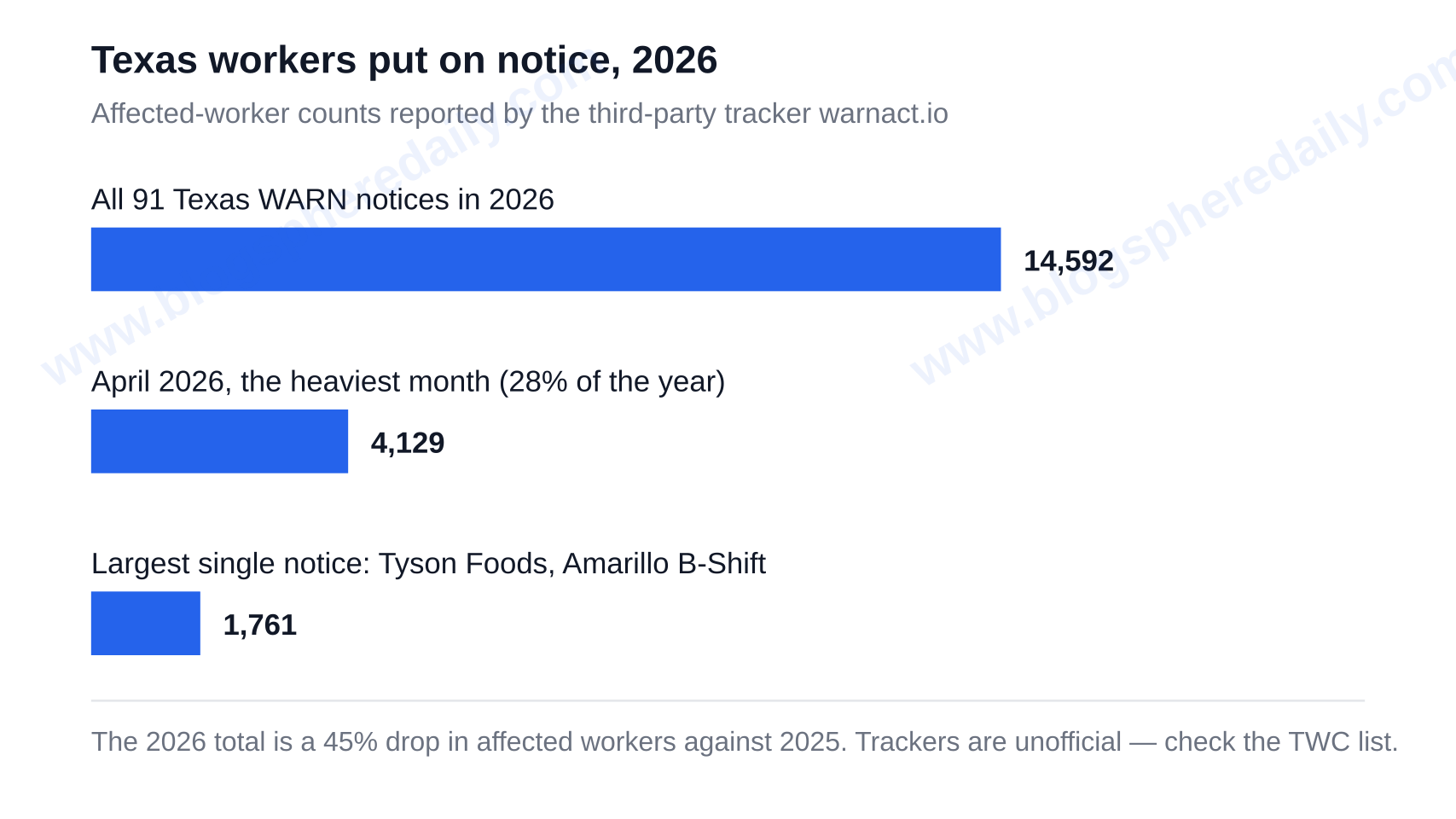
Third-party trackers collect, compile, and republish the TWC filings with dashboards and alerts. They are useful for trend views and unofficial by nature. One such tracker, warnact.io, reports 91 Texas WARN notices in 2026 putting 14,592 workers on notice — a 45% drop in affected workers against 2025 — with April the heaviest month at 4,129 affected workers, or 28% of the year’s total, and the single largest notice coming from Tyson Foods, Inc. (Amarillo B-Shift Operations) at 1,761 jobs, filed 01/26/2026. For scale, Fox 7 Austin reported that more than 60 Texas WARN notices in 2024 impacted just over 6,500 people statewide. Again, verify any number against the TWC list before you rely on it.
Now the limits of the list. The list only shows the employer, the site, the county, the effective date, and the number impacted. The list does not tell you whether the notice was legally adequate or timely. Also, a missing filing is not proof of a violation — the layoff may have simply fallen under the thresholds at that single site.
What should a laid-off Texas worker do during the 60-day notice period?
Start with the deadline no WARN explainer connects to a layoff. The Texas Payday Law states that final pay for an employee who is laid off, discharged, or otherwise involuntarily separated is due within six calendar days of discharge — unlike the next regularly scheduled payday for an employee that resigns. According to the TWC, holding a final paycheck past that deadline is not legal, whatever the stated reason: unreturned company property, an unsigned timesheet, missing paperwork. The employer’s remedy for a laptop you still have is a separate claim, not withholding your pay.
If the six days pass, pursuing the Texas Payday Law wage claim through the TWC is a real administrative remedy, it is free, and it is completely separate from a WARN suit in federal court. You can do both.
Time your claim for unemployment benefits to line up with the actual stop date. You typically can’t claim until you are out of work and wages have stopped, so a notice period in which you are still working is not a claimable period. File as soon as the separation takes effect, not when the letter arrives.
Here’s some advice that’s still valuable while you’re still on payroll. Severance isn’t required in Texas and is not a substitute for WARN notice — but accepting it almost always means signing a release, so read it specifically for a WARN waiver before you sign. Use Rapid Response services now; they are designed to run during the notice period, not after it. And keep the notice letter, the separation schedule, and every revised date you receive. These documents are the case in a WARN claim.
The short version: there is no Texas version of the WARN Act, so the federal 100-employee, 60-day, 50-or-500 framework decides everything — and the single-site test is what most often determines whether a Texas layoff triggers the law at all. Workers enforce it themselves in federal court. Employers file with TWC and with the local chief elected official, on the same day, with proof.
What you need to do next: pull the current list from TWC’s WARN notice page or the data.texas.gov dataset and check whether your employer filed, then run the three-step test above against your own site’s headcount. What to watch from here is state law, not federal. Mini-WARN bills keep returning to legislatures around the country, and if one ever passes in Austin, the thresholds on this page are the first thing that changes. For other pieces in this vein, see Blog Sphere Daily.
FAQ
Can an employer in Texas lay you off without any notice?
Usually, yes. Texas is an at-will state for employment. An employer can end your employment with no advance notice, unless there is a contract or union agreement stating otherwise. The federal WARN Act is the narrow exception: it requires 60 calendar days’ written notice only when the employer has 100 or more full-time employees (or 100 employees working a combined 4,000+ hours a week) and the action is a qualifying plant closing or mass layoff at a single site. If the layoff does not meet those thresholds, no notice is owed.
Do you get paid during the 60-day WARN notice period in Texas?
Yes — if you are still employed during those 60 days, you are paid as normal, because WARN requires notice, not paid leave. That is the whole point of advance notice: you keep working and earning while you look for the next job. If the employer skips notice instead, its exposure is back pay and benefits for each day of violation, capped at 60 days or half your length of service, whichever is shorter. Either way, your final paycheck is due within six calendar days of an involuntary separation under the Texas Payday Law.
Does a WARN notice mean the layoff is definitely happening?
Not necessarily. A business’ plans and expectations can change — closings get postponed, scaled back, or called off when financing or orders come through. A WARN notice only states the employer’s expected date of first separation and the separation schedule it anticipates. What you should watch for is a revised date: if separations are pushed beyond the original 60-day window, the employer generally has to issue fresh notice. In the end, the dates are the core evidence in any later WARN claim, so keep the original letter and every update you receive.