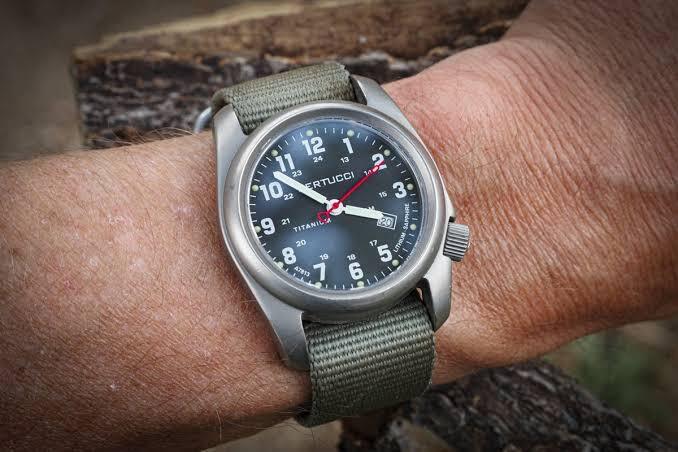
1700 military time is 5:00 PM in standard 12-hour time and is written as 17:00 on a 24-hour clock. To convert, simply subtract 1200 from 1700 to get 500 and then add PM. It is spoken as “seventeen hundred” or “seventeen hundred hours.” It is NEVER spoken as “one thousand seven hundred.”
A message that says “report to the motor pool at 1700” means that the individual is to report to the motor pool at 5:00 PM. That much, of course, is elementary and is reflected on every converter page. What is not reflected is the significance of 1700 being on more military schedules than almost any other number and how to tell whether the 1700 you were given is local time or Zulu time, because they are, in fact, different moments.
What time is 1700 military time in regular time?
1700 = 5:00 PM = 17:00. Late afternoon tipping into early evening. It is always PM and never AM, because the 24-hour clock has already passed noon by the time it reaches 17.
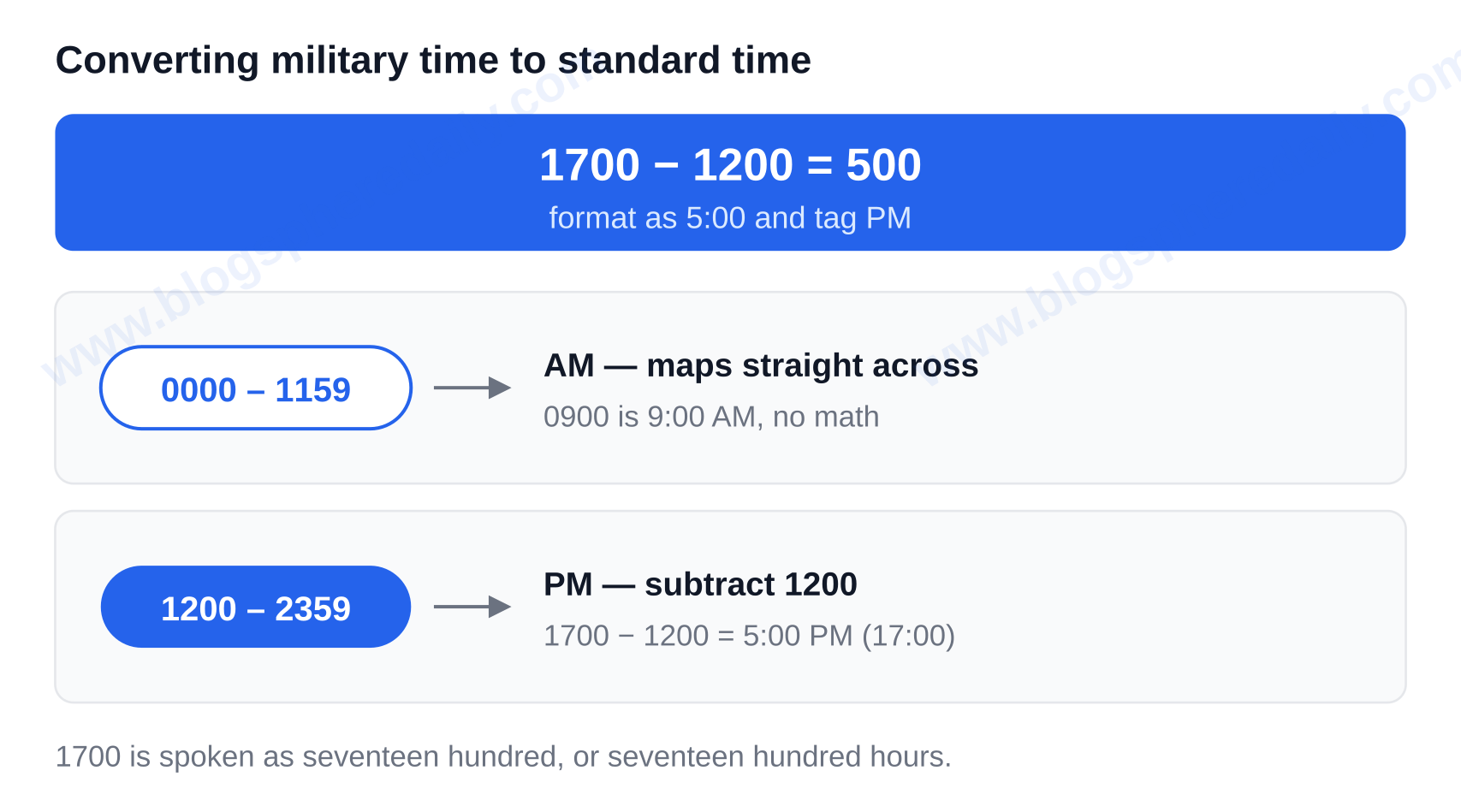
The arithmetic is one line, and it works on any military time above 1159: 1700 − 1200 = 500, which you format as 5:00 and tag PM. Inch Calculator runs the same subtraction on its converter page.
To find the answer, use the following rule: If the number is between 0000 and 1159, then it’s AM time and maps straight across — 0900 is 9:00 AM, no math. If it is between 1200 and 2359, then it is PM time and needs the subtraction. That is the whole system.
How to convert 5:00 PM to military time
The rule to figure out military time is the same for figuring out regular time, run backwards. Simply add 12 to the hour to get the new hour. 5 + 12 = 17. Therefore, 5:00 PM is 1700. Four digit military time has no colon or meridiem.
If you are entering hours on a timesheet rather than reading a schedule, 1700 means 17.0 decimal hours, and the minutes portion is zero, thus there is nothing after the decimal point.
How do you say 1700 out loud?
“Seventeen hundred” is the correct, common way to say it. Using the formal way to say it, in writing or a briefing script, would be “seventeen hundred hours.” Both are correct; the second is just the fuller form.
The rule provided is more useful than the example, as it is generalized. According to Wikipedia’s 24-hour clock reference, when speaking about the 24-hour clock, hours are always spoken as “a hundred” and never as “a thousand” — 1000 is “ten hundred,” 2000 is “twenty hundred.” Knowing this, you would never have to look up how to say a given hour.
When speaking about the 24-hour clock, there are three common mistakes that indicate a person is not used to speaking about this clock:
- “One thousand seven hundred” – the thousand does not appear.
- “Seventeen o’clock” – “o’clock” is not used with the 24-hour clock.
- “One seven zero” – reading digit-by-digit is only used for radio communications.
Leading zeros are spoken as well, not just written. The same source states that 5:43 a.m. would be “zero five forty-three” in common speech or “zero five four three” in a radio transmission, where clarity beats speed.
1700 is easy. No minutes mean you stop at the hour. Once minutes appear, ‘Hundred’ goes away. So 1715 is ‘seventeen fifteen’ and 1745 is ‘seventeen forty-five.’
Why 1700 shows up on more military schedules than any other time
Because it is not an arbitrary 5 PM. 1700 is a signal for the end of the duty day, and it is marked out loud.
Flag lowering ceremonies happen at U.S. military installations worldwide. On base, at 1700 local time the U.S. flag is lowered and the bugle call Retreat is played to signal that the official duty day is over. Per the U.S. Army’s account of the ceremony, Retreat is followed immediately by To the Colors, with a gun being fired between the two on many installations.
That changes how you read the number. ‘1700’ means something. It’s usually close of business, the end of the day, the last time something can happen, the deadline. It is not a neutral timestamp someone picked. If an email says ‘reply by 1700’ that means stop replying at 1700, not ‘at or around 1700.’ In practice, if a suspense says 1700, treat it as a hard stop rather than a suggestion.
What Retreat at 1700 means if you are on base
On base, if you hear Retreat, you stop what you’re doing, pull over if you’re in a vehicle, and face the flag and render the honors. If the flag is not visible, face the direction of the music if you can. It lasts under a minute, and standing still through it is the whole etiquette.
For a civilian reading military correspondence, here is the reframe worth keeping: 1700 is the military equivalent of 5 PM as the end of the work day. Same hour, but in the military this gets signaled by a bugle call.
Is the 1700 in front of you local time or 1700 Zulu?
This is a question the converter pages never ask, and it is the one worth knowing. Literally showing up at 1700, as opposed to 1700 Zulu, are two different wall-clock moments.
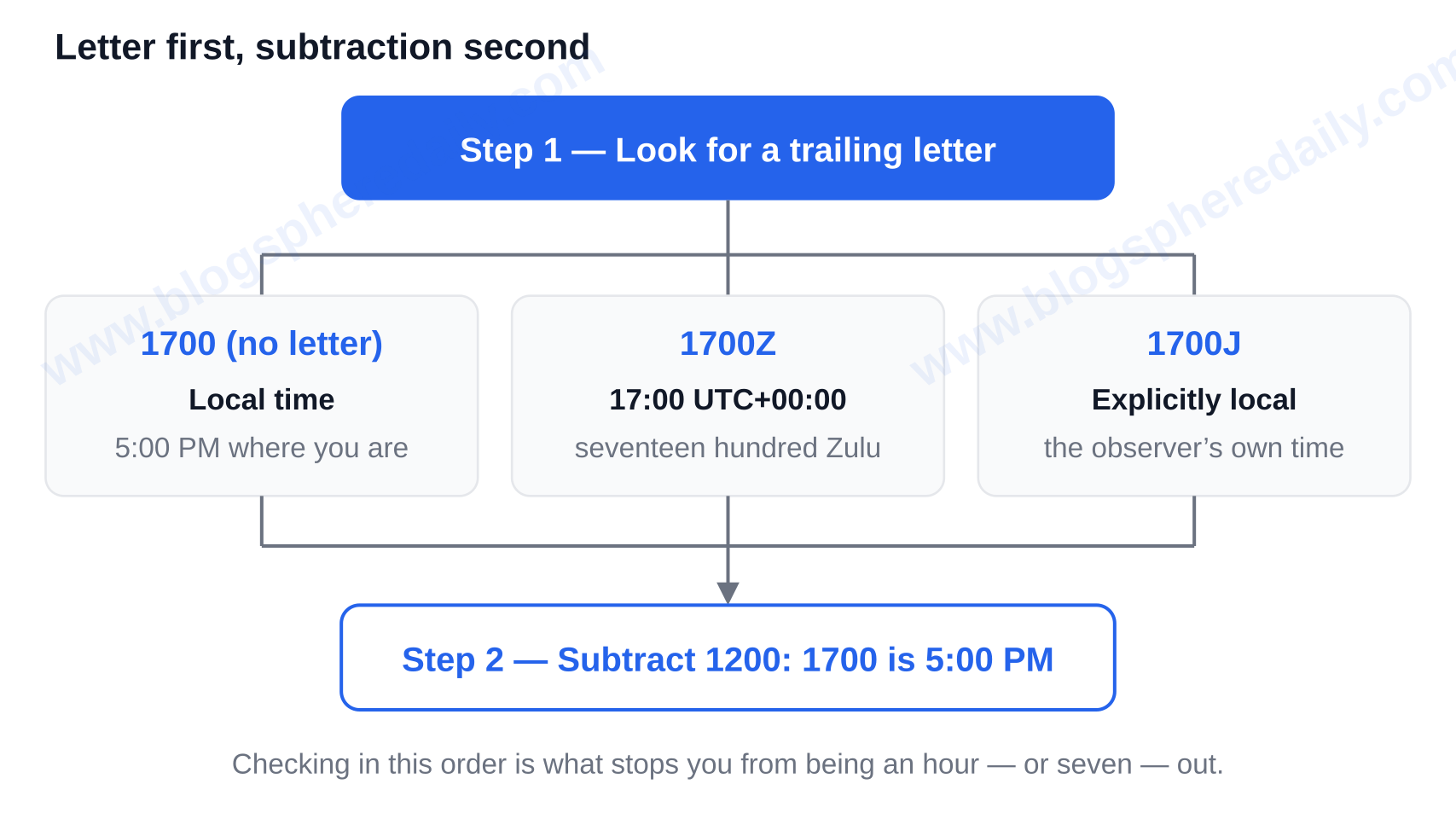
The decision rule is really simple. No trailing letter means local time. So 5:00 PM where you are. A trailing Z means 17:00 Coordinated Universal Time, spoken “seventeen hundred Zulu.”
What the Z in 1700Z actually means
Z is Zulu, which is UTC+00:00. The reason Zulu time is so dominating is because it offers one true instant in time for everyone, everywhere, which is why it dominates aviation flight plans and any operation spanning more than one time zone.
The rest of the alphabet has offsets as well. Wikipedia’s military time zone reference states letters A through M run eastward with positive offsets, and N through Y run westward with negative offsets, each drawn from the NATO phonetic alphabet. J is an exception. It was skipped in the fixed sequence, and it is now used to designate the observer’s own local time, so 1700J explicitly means local. A lettered time is written with the letter attached, and spoken with the phonetic word. 0600R is “zero six hundred Romeo.”
As a sanity check before acting on any time you have been handed, look for the letter first, and do the subtraction second. Checking in that order is what stops you from being an hour — or seven — out.
The four ways 1700 gets written — and how each one is read
There are four ways to write 1700, and four ways to say it. Same instant, four notations. Here is the whole set, along with its spoken form beside it.
| Notation | Written as | Spoken as | Where you see it |
|---|---|---|---|
| U.S. military | 1700 | “Seventeen hundred” / “seventeen hundred hours” | Orders, rosters, schedules, military correspondence |
| Civilian 24-hour clock | 17:00 | “Seventeen hundred” or “seventeen hours” | Software timestamps, international business, transport timetables |
| 12-hour standard time | 5:00 PM | “Five PM” / “five o’clock” | Everyday U.S. civilian use |
| Zulu (UTC) | 1700Z | “Seventeen hundred Zulu” | Aviation, multi-zone operations, flight plans |
The visual tell, worth internalizing, is to remember the colon separates U.S. military notation from civilian 24-hour notation. Both clocks mean the same moment, just one keeps the punctuation.
The military clock, in one place, is always written with four digits, no colon, no AM/PM marker, and leading zeros written out for every time before 1000–0700, not 700. The civilian 24-hour clock keeps the colon and aligns with ISO 8601. This is why timestamps in software and global business look the way they do.
A minor, dated observation for people working with older documents. The Wikipedia article on the 24-hour clock records that the U.S. Navy and Marine Corps correspondence manual used to define the range as 0001 to 2400 and was changed to 0000 to 2359 in June 2015. Prior to 2015, the Navy and Marine Corps would not have written midnight the same way, which is important to know the moment you switch from a mid-afternoon time like 1700 to the start or end of the same day’s schedule.
Converting the times around 1700 without doing the math again
A schedule is made up of many individual lines, and most people are decoding the whole thing, not one line of it. The hours surrounding 1700 are:
- 1600–4:00 PM
- 1700–5:00 PM
- 1730–5:30 PM
- 1800–6:00 PM
- 1900–7:00 PM
- 2100–9:00 PM
Within the 1700 hour, minutes behave simply: the hour digits stay the same and the minute digits carry straight over. So 1715 is 5:15 PM. 1759 is 5:59 PM. No separate step.
The full day fits in a sentence. There’s nothing complicated about representing hours from 0000 to 1159 as AM and representing hours from 1200 to 2359 as the difference from 1200.
And this clock reaches well past the armed forces. Aviation, nursing and healthcare, all forms of EMS and emergency services, logistics and global business have all adopted this clock for the same reason: dropping AM/PM drops the ambiguity that causes 12-hour errors. Medications, flight times and shift starts can all be represented in an unambiguous format by using the 24-hour clock — which is the entire point.
The one line to keep
1700 is 5:00 PM, 17:00 on a 24-hour clock, spoken “seventeen hundred.” What the converter pages omit are that it generally signals the end of the duty day and that a trailing Z changes the hour completely. So before you act on any military time you have been handed, check for a trailing letter first, then subtract 1200. Browse more in Business.